Jack Doherty Shuffle Deal: Why His Sponsor Wants Him Offline
 Alex Harper • Oct 14, 2026


Editorial Statement: At CasinoUS, we independently review and select the online casinos featured on our site. We assess each operator using consistent criteria covering licensing, security, payments, payouts, bonuses, games, customer support and responsible gambling.
We may earn commissions when readers use certain affiliate links. However, commercial relationships do not determine which casinos we feature or how we evaluate them. We highlight both strengths and limitations so that US players can make more informed decisions.
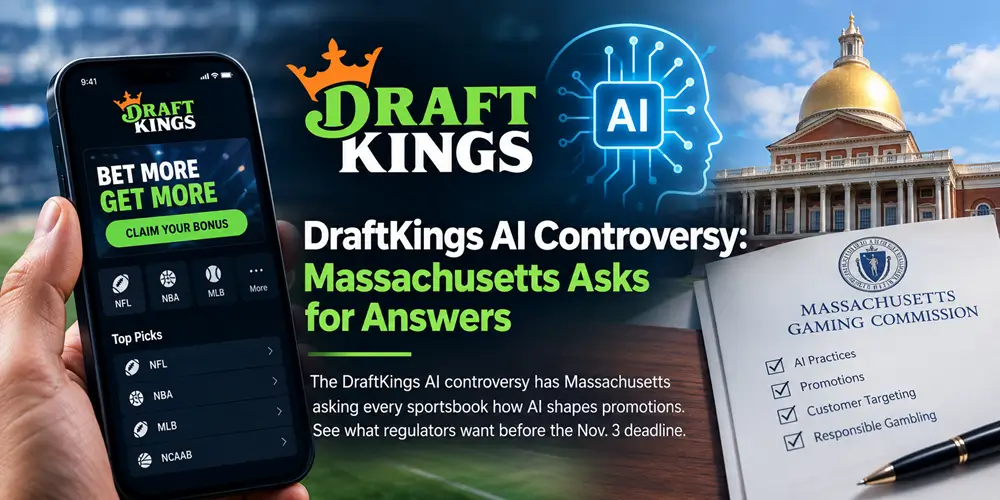
Massachusetts regulators are asking every licensed sportsbook how it uses AI to pick who gets promotions. The DraftKings AI controversy prompted those questions. On October 9, 2026, the Massachusetts Gaming Commission (MGC) sent operators a detailed AI questionnaire. Written answers are due by November 3, 2026.
For bettors, the core worry is simple: are betting apps using AI sports betting promotions to keep losing customers playing? A New York Times investigation and a proposed class action lawsuit both claim DraftKings did exactly that. However, DraftKings denies the allegations, and no court or regulator has made any finding against the company.
The story started with a newspaper investigation, not a regulator. Here is how events unfolded.
| Date (2026) | Development |
| September 19 | The New York Times publishes its investigation into DraftKings’ use of AI in marketing |
| September 24 | MGC Chair Jordan Maynard directs staff to engage with all sports wagering operators on AI |
| September 30 | Daniel Vest files a proposed class action against DraftKings in Boston federal court |
| October 9 | Executive Director Dean Serpa signs the AI letter to Massachusetts operators |
| October 14 | The MGC publishes the letter on its website |
| November 3 | Deadline for operators to submit written responses |
In the Times reporting, former DraftKings staff described targeting losing gamblers with promotions that encouraged more betting, WBUR reported. Boston.com reported that the Times also found internal efforts to use similar tools to protect vulnerable bettors were shut down. DraftKings disputed the report and rejected any suggestion that its marketing was unfair.
The confirmed record is narrower than many headlines suggest. The MGC letter, the lawsuit, and DraftKings’ denial are documented. Still, the claim that DraftKings used AI to target losing bettors remains untested by any court or regulator.
The MGC wants a separate written answer to every question in an eight-part letter. The commission’s announcement says commissioners requested the letter, and it went to all licensed sports wagering operators in the state.
Notably, the request is voluntary. The letter says the MGC will keep responses confidential and use them to develop AI policy. In plain terms, this is an information request, not an investigation finding, a fine, or a new rule.
The letter also defines AI very broadly. It covers any tool that ranks, scores, or predicts patron behavior, whatever the operator calls it. The definition even includes systems where a human reviews the output before anyone acts on it.
Several questions mirror the allegations against DraftKings. Regulators want to know whether operators:
Operators that answer no to that last question are asked to explain what controls stop it from happening.
The final section tests whether operators can explain their own systems. It asks whether staff can override a model. It also asks if operators can explain why one patron got one promotion on a given date.
Machine learning is software that finds patterns in past data to make predictions. In sportsbook marketing, those predictions can shape who gets which offer, and when. The examples below describe general industry capabilities, not confirmed DraftKings practices.
The MGC letter itself lists the main ways this can work:
That same pattern-spotting can work in the opposite direction. For example, a model that spots rising deposits could pause marketing or suggest a deposit limit. Whether AI helps or harms depends on its goal, its data inputs, and the safeguards around it.
Massachusetts rules already draw some of these lines. Under 205 CMR 257.02, operators cannot use patron data to push offers based on a period of not betting. They also cannot use AI that they know, or should reasonably expect, will make the platform more addictive. Additionally, operators must report responsible gambling data trends to the MGC at least every six months.
The lawsuit puts the reporting to a legal test, and WBUR noted the complaint repeatedly quotes the Times investigation.
Vest says he spent thousands of dollars with DraftKings, according to Boston.com. He also says he received at least 70 emails, texts, or notifications in one month. The complaint alleges a model scored users and labeled some “elastic,” meaning likely to respond to incentives. Those users allegedly received extra messages and promotions without being told why.
The legal theory centers on DraftKings’ privacy notice. That notice says the company may use customer data to assess whether people are playing responsibly. Vest argues DraftKings used the data for the opposite purpose, breaking a promise to customers.
DraftKings has denied the allegations. Spokesperson Park Winslow told WBUR the company does not use AI to target customers based on losses. The statement added that DraftKings also does not use AI to target customers based on signs of potential problem gambling.
The company also said it intends to “vigorously defend” any lawsuits on the matter. As of October 15, 2026, a judge has not certified the class.
Operators are asked to email their written answers to the MGC’s sports wagering division by November 3, 2026. Because the responses are confidential, the public may never see what each operator said.
The MGC has not announced hearings, enforcement plans, or new reporting rules tied to the letter. Chair Jordan Maynard has said the commission will decide on any further action or policy later, if and when appropriate.
After the deadline, watch for three things:
Investors are watching too, and our DraftKings stock forecast covers the wider pressures on the company.
Massachusetts is ahead of most states on this issue. MGC Commissioner Paul Brodeur said Massachusetts may be the only state that references AI in its rules, CDC Gaming reported.
Other regulators are paying attention. The Michigan Gaming Control Board said it is reviewing the issues raised in the reporting. However, it did not commit to a DraftKings-specific review, and Michigan’s rules do not mention AI.
If other states act, the Massachusetts questionnaire offers a likely template. Possible changes include AI disclosure rules, records explaining each targeted offer, and limits on using losses in marketing. These remain possibilities, and no other state had announced AI promotion rules as of October 15, 2026.
Nothing changes about your account for now, but the offers you receive deserve a closer look.
Different customers often get different promotions, and that alone proves nothing about AI targeting. If offers spike after losses or a break, you can usually opt out of marketing in account settings. If you bet with DraftKings, our DraftKings Sportsbook review explains how its promotions work.
Before claiming any offer, read the terms. Check the minimum odds, the expiry date, and whether a bonus bet pays back your stake or only the winnings. If you are betting in the Bay State, our Massachusetts gambling guide covers local rules and options.
Set a dollar limit before you bet, and stop when you reach it. Deposit limits, time-outs, and self-exclusion programs are offered by most licensed US sportsbooks. Our responsible gambling guide explains how each tool works.
If betting no longer feels like fun, help is free and confidential. Call or text the National Council on Problem Gambling’s helpline at 1-800-MY-RESET (1-800-697-3738), available 24/7. You can also learn the signs of a gambling problem and how to support someone affected.
These answers cover the questions bettors are searching for most.
The DraftKings AI controversy centers on claims that the company used machine learning to target likely losers with promotions. The claims come from a September 2026 New York Times investigation and a federal lawsuit filed September 30.
DraftKings denies the allegations, and no court has ruled on them.
The MGC launched its review after the Times report on DraftKings, but it covers every licensed operator. The October 9 letter asks how AI shapes who gets promotions, which offers they get, and when.
The commission says it will use the confidential answers to develop AI policy.
No. DraftKings says it does not use AI to target customers based on losses or signs of potential problem gambling. The company also says it will vigorously defend against any lawsuits.
The allegations remain unproven, and the federal case is at an early stage.
The deadline is November 3, 2026. The MGC asked operators for a separate written answer to each numbered question and bullet point in its letter.
Participation is voluntary, and the commission says responses will stay confidential. Any follow-up action would come later, if the commission decides one is needed.
Possibly, but nothing is confirmed. The MGC says it will use operator responses to develop AI policy, which could later shape new rules.
Massachusetts already bans AI that operators know or reasonably expect will make platforms more addictive. Any new rule would likely go through the MGC’s public rulemaking process first.
The DraftKings AI controversy has moved from a news story to a live regulatory and legal question. The next markers are the November 3 deadline, any MGC discussion of the responses, and DraftKings’ answer in federal court. Until then, the allegations remain unproven. Bettors gain most by reading offer terms and using the limits available to them.
 Alex Harper • 10 min
read
Alex Harper • 10 min
read
 Alex Harper • 10 min
read
Alex Harper • 10 min
read
 Alex Harper • 10 min
read
Alex Harper • 10 min
read
 Alex Harper • Oct 14, 2026
  Lara Johns • Oct 13, 2026
  Alex Harper • Oct 12, 2026
  Alex Harper • Oct 12, 2026
 Editorial Statement: Casino US is your trusted source for timely industry updates, in-depth analysis, and honest operator reviews. Our editorial team brings years of specialized gaming industry knowledge to every story, holding ourselves to strict standards of accuracy and objectivity. We're dedicated to providing straightforward, unbiased, and reliable reporting on the US gambling landscape and beyond.