Inside the $5.7M Westchester Real Estate Gambling Scam
 Alex Harper • Nov 12, 2026

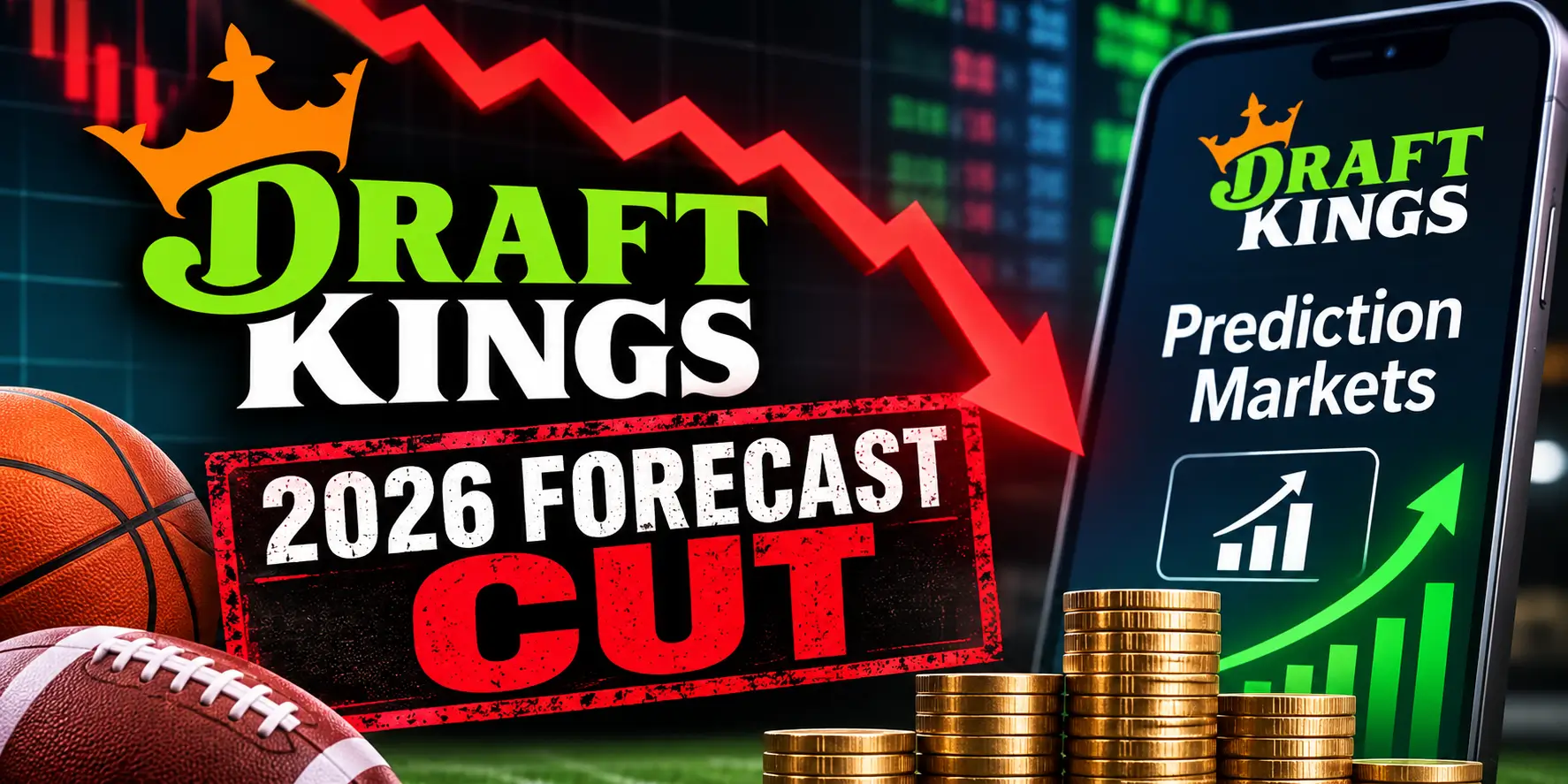
DraftKings prediction markets just cost the company a chunk of its market value, with shares falling more than 28% after management told investors it would pour as much as $700 million into the new business this year and take a big bite out of 2026 profit guidance in the process. The stock dropped roughly 27% on the day of the announcement, and has since slid further, hitting its lowest level since early 2023 and sitting around 80% below its all-time peak. The sell-off handed Wall Street a blunt message: the sportsbook giant is willing to trade near-term earnings for a seat at the prediction-market table, even if investors aren’t ready to pay for the ticket.
Fact checked by Paige Williams
Editorial Statement: At CasinoUS, we independently review and select the online casinos featured on our site. We assess each operator using consistent criteria covering licensing, security, payments, payouts, bonuses, games, customer support and responsible gambling.
We may earn commissions when readers use certain affiliate links. However, commercial relationships do not determine which casinos we feature or how we evaluate them. We highlight both strengths and limitations so that US players can make more informed decisions.
The headline numbers tell the story. DraftKings cut its 2026 adjusted EBITDA forecast to a range of $175 million to $275 million, down from a prior range of $700 million to $900 million. It also lowered 2026 core revenue guidance to $6.35 billion to $6.55 billion from $6.5 billion to $6.9 billion. Management said the revised outlook is almost entirely about one thing: funding a far bigger push into its DraftKings Predictions platform than Wall Street expected.
Adjusted EBITDA is a measure of operating profit that strips out items like interest, taxes, and depreciation. It’s a figure sportsbooks use to show how much cash their core business is generating before accounting choices muddy the picture. DraftKings didn’t cut the number because the sports betting business suddenly broke. It cut the number because it is choosing to spend heavily on prediction markets.
The revised 2026 guidance now builds in a full-year Predictions adjusted EBITDA investment of $650 million to $700 million, including $175 million to $225 million in the fourth quarter alone. That is a sharp increase from the plan the company was running with a few months ago. Predictions spending was previously guided at $200 million to $300 million. In other words, management more than doubled the budget for a product line that is still in its early days.
Third-quarter results didn’t help the mood either. DraftKings posted a $316.9 million adjusted EBITDA loss in the quarter, compared with a $126.5 million loss a year earlier. Consensus had been for a loss of around $68 million. The reported loss of 53 cents per share was wider than the 41-cent loss analysts had modeled.
Strip out the Predictions spending and the core sportsbook and iGaming business is still generating meaningful profit. DraftKings guided its core business to roughly $1.15 billion to $1.25 billion of 2027 adjusted EBITDA — a figure larger than what some analysts had been modeling for the whole company. The pain is concentrated in the prediction-markets build-out.
The $700 million figure that drew all the attention is not a lump sum DraftKings is writing out of its treasury. It is the high end of the adjusted EBITDA hit the Predictions business is set to produce across 2026 — essentially the negative profit contribution from running the product, paying promotions, acquiring customers, and building the platform. Most of that spend has already landed through the first three quarters, with a further $175 million to $225 million earmarked for Q4. DraftKings expects Predictions revenues of $650 million to $750 million in 2027, with the EBITDA drag narrowing considerably in the second year.
Much of the 2026 spend has gone on customer acquisition. New-customer promotions have offset most of Predictions’ gross revenue this year, meaning the business is essentially paying users to try it. Early metrics help explain why management is willing to swallow that: DraftKings said it had acquired roughly 1 million prediction-market customers in three months, with more than 1.6 million users engaging with the product so far this year. The company expects its 2026 customer cohort to pay back acquisition costs in about 20 months, ahead of a two-year internal target, and to generate roughly $350 million in gross profit during 2027.
Strategically, Predictions is DraftKings’ attempt to meet new competitors where they live. Prediction-market platforms Kalshi and Polymarket have exploded in volume over the last year, much of it on sports-related contracts, and they operate under a different regulatory structure than a traditional sportsbook. DraftKings’ pitch to investors is that it cannot sit out while a federally regulated product class siphons off sports-related wagering activity, especially in states where legal sports betting doesn’t exist.
Investors reacted to a mix of things, and most of the reasoning is analyst interpretation rather than confirmed company commentary.
The first issue is magnitude. Doubling the Predictions budget turned 2026 from a year of expected earnings growth into one with barely any profit at all. The second is time horizon. DraftKings is asking shareholders to look past 2026 and trust that the customers it’s buying today will still be worth owning in two years. That assumes the regulatory picture holds, the products stay legal, and the economics look anything like what management is modeling.
Analysts moved quickly. UBS downgraded the stock to Neutral from Buy and cut its price target to $22 from $48. Analyst Robin Farley said it was “difficult to place meaningful value on the prediction markets business given uncertain regulatory outlook.” JPMorgan and Stifel also downgraded the shares. Citizens noted that the $225 million midpoint of 2026 EBITDA guidance sits about 65% below the roughly $644 million consensus before the announcement.
There is also an execution concern. Running a sportsbook and running a CFTC-regulated event-contract exchange are different businesses with different compliance stacks, product mechanics, and customer behavior. DraftKings is trying to do both, in a legal environment that is actively being contested.
A prediction market is an exchange where users buy and sell contracts tied to the outcome of a real-world event — an election, a weather reading, a game result. The contract pays out if the event happens and expires worthless if it doesn’t. Prices move with demand and function like a probability estimate. The appeal for sports fans is that the odds look and feel a lot like American-style betting lines, even though the underlying instrument is a financial contract rather than a wager with a bookmaker.
The product differences matter. A sportsbook sets lines, takes the other side of bets, and manages risk on its own book. A prediction market matches buyers and sellers and takes a fee. That structural difference is the basis for the regulatory argument that sports event contracts are federally regulated derivatives rather than state-licensed gambling.
The commercial reality is that these platforms have grown very quickly. As of early 2026, roughly 87% of Kalshi’s $39.7 billion in annual trading volume was tied to sports. Combined monthly trading volume on Kalshi and Polymarket rose from under $5 billion in September 2025 to around $24 billion by April 2026. That is the growth curve DraftKings doesn’t want to cede, and it’s the reason FanDuel is in the same race.
FanDuel, owned by Dublin-listed Flutter Entertainment, is also investing aggressively in prediction markets. Flutter’s US adjusted EBITDA fell 94% to $3 million in the most recent quarter after it ramped up prediction-market spending, and Flutter’s US leadership team signaled marketing intensity would remain elevated into 2027. In practical terms, the two biggest US sports betting operators are both pouring money into the same emerging category at the same time.
Where they differ is strategy and capital structure. Flutter is a much larger global company with cash flow from international operations in markets like the UK and Australia. DraftKings is a US-focused pure play without that cushion, which is one reason a spending pivot shows up so sharply in its guidance.
Both companies are responding to the same competitive threat from Kalshi and Polymarket, but DraftKings’ announcement is the clearest signal yet that the sports-betting incumbents have decided they cannot wait out the regulatory fight from the sidelines.
Prediction markets occupy a legal space that isn’t fully settled. Platforms like Kalshi and Polymarket are regulated federally as Designated Contract Markets by the Commodity Futures Trading Commission under the Commodity Exchange Act. That federal oversight has allowed them to operate in all 50 states, including states where sports betting is not legal.
States have pushed back. Nevada, New Jersey, and Maryland have each moved to block Kalshi from offering sports prediction markets, arguing the contracts amount to unlicensed sports betting under state law. More than 30 states and the District of Columbia have filed amicus briefs supporting state authority. The CFTC has filed briefs defending its own jurisdiction, and federal courts have so far generally sided with it. For readers tracking the policy side, our sports betting regulation hub keeps running coverage of the state and federal fights.
The regulatory direction is also shifting. CFTC Chair Michael Selig said in January 2026 that the agency would move forward with a prediction-markets rulemaking, and in February 2026 the CFTC withdrew an earlier notice of proposed rulemaking and a 2025 staff advisory. The CFTC has since proposed new rules that could restrict certain sports contracts, such as those tied to officiating outcomes or player injuries.
Nothing here is a settled legal question. Access, product scope, and even the long-term legality of sports-related event contracts could shift depending on how rulemaking, state litigation, and congressional action land. Readers should always check applicable laws in their own state before using any betting or prediction-market product.
For the end user, the most immediate effect is choice. DraftKings is building a product that sits alongside its sportsbook, offering event contracts on sports and other outcomes. If it works, bettors in some states will have a federally regulated alternative to their state-licensed sportsbook. In states without legal sports betting, a prediction-market product may be one of the few legal ways to take a position on a game, assuming the regulatory status of those contracts holds.
Competition typically pushes pricing in the customer’s favor. More operators chasing the same users tends to mean more promotions, sharper odds, and better product features. That said, prediction-market pricing works differently from a traditional sportsbook, and the two products are not interchangeable from a legal or tax perspective.
Availability will continue to depend on jurisdiction. State laws differ, litigation is active, and what is accessible today may change.
A few things are worth watching. The first is whether the Predictions acquisition cohort actually pays back on the 20-month timeline management is forecasting. The second is the 2027 EBITDA trajectory. DraftKings said its Predictions business would consume a further $250 million to $350 million in adjusted EBITDA in 2027, with the core sportsbook and iGaming business expected to deliver more than $1 billion. The gap between those numbers is the bull case. For ongoing coverage of operator earnings and strategy shifts, our sportsbook news desk follows the quarterly cycle.
The third is regulation. Any shift in CFTC rulemaking, a court decision on a state preemption challenge, or federal legislation could reshape what DraftKings is allowed to offer and where. Investors and bettors should pay attention to court dockets and CFTC notices as much as earnings calls over the next 12 months. Competitive responses from FanDuel, BetMGM, Caesars, and smaller operators are the fourth variable, as is whether Kalshi and Polymarket keep growing at the rate they did in 2026.
DraftKings didn’t just cut a forecast. It redrew its business plan in front of shareholders who weren’t ready for it. The company is betting that prediction markets are not a passing fad but a durable product category that will eat into traditional sportsbook activity if incumbents don’t compete directly. Whether that bet pays off will shape the US betting market for years, not just DraftKings’ 2026 earnings.
The sell-off reflects doubt, not disproof. If the Predictions economics work, 2026 will be remembered as a transition year. If they don’t, it will be remembered as the moment DraftKings spent heavily chasing a market it couldn’t win.

 Lara Johns • 10 min
read
 Lara Johns • 10 min
read
 Alex Harper • 10 min
read
 Alex Harper • Nov 12, 2026
 Lara Johns • Nov 11, 2026
 Alex Harper • Nov 11, 2026
 Alex Harper • Nov 11, 2026