Hollywood Betting Ban: Studios Block Staff Bets
 Alex Harper • Nov 6, 2026

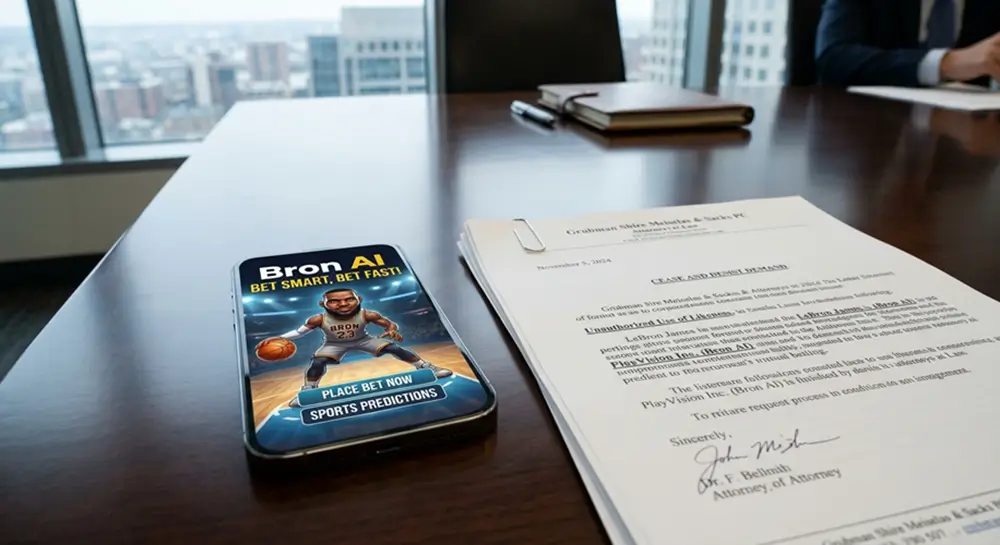
LeBron James is pushing back against an AI sports betting app that put a version of him on screen without asking. The Philadelphia 76ers star has sent a cease and desist letter to Bron AI after the platform ran a promotional ad featuring an AI-generated character that resembles him, wears his familiar No. 23, and carries the nickname “Bron” across its back. James says he has no affiliation with the company, and his representatives want the ad gone.
Fact checked by Paige Williams
Editorial Statement: At CasinoUS, we independently review and select the online casinos featured on our site. We assess each operator using consistent criteria covering licensing, security, payments, payouts, bonuses, games, customer support and responsible gambling.
We may earn commissions when readers use certain affiliate links. However, commercial relationships do not determine which casinos we feature or how we evaluate them. We highlight both strengths and limitations so that US players can make more informed decisions.
The dispute, first reported by Front Office Sports, has quickly become one of the most talked-about stories at the intersection of sports betting, celebrity rights, and AI-generated advertising. It has also pulled in another NBA star, Luka Dončić, whose representatives reportedly sent their own cease and desist letter after his image appeared in the same promotion.
According to Front Office Sports, a spokesperson for James confirmed that his legal team sent a cease and desist letter to Bron AI, an AI-powered sports betting app that “evokes his name and uses his likeness without authorization.” The letter was issued by the law firm Grubman Shire Meiselas & Sacks PC, which demanded that Bron AI permanently stop using James’s likeness “in any manner and media,” including removing the ad.
The letter goes further than a simple takedown request. It also says the company must notify every person who has used the app, in writing, that James has no involvement with the company.
The reason cited for the cease and desist, per Front Office Sports, is the “unauthorized use and illicit exploitation of” the 76ers star’s “name, nickname, likeness, image, persona, and other identifying attributes, materials and related information” to create the appearance of an association between the two sides.
An attorney issued the cease-and-desist letter on the 76ers star’s behalf to PlayVision Inc., the sports technology startup that owns Bron AI.
The promotional video is at the center of the dispute. According to Front Office Sports, the video was posted on Wednesday, November 4, by Bron AI CEO Anish Gupta, who introduced the platform as “The TikTok for Sports Betting.” The AI-generated character, whose voice also resembles James’, scrolls through the app before landing on Phoenix Suns forward Dillon Brooks.
The combination of details is what has drawn the strongest response. “The combination of the nickname ‘Bron,’ the number 23, and the physical presentation, as well as the similarity in voice, seems designed to evoke him and capitalize on his stature in connection with an unrelated sports betting product,” representatives for James said.
The ad’s reach also shifted quickly. A representative for Luka Dončić said he has also sent a cease and desist letter to Bron AI, and Yahoo Sports noted that the ad was removed from X soon afterwards.
Bron AI markets itself as a tool aimed at helping users think through sports wagers. According to an NBA spokesperson, the Philadelphia 76ers star has sent a cease and desist letter to Bron-AI, a platform that promotes itself as a tool for identifying potentially profitable sports wagers.
The company behind it is PlayVision Inc., and the public face of the launch has been co-founder and CEO Anish Gupta. Gupta posted the ad to his page on X, with the description, “Meet Bron: The TikTok for Sports Betting.”
Beyond those descriptions, independent details about the app’s underlying functionality, licensing status, and data sourcing remain limited. Neither Bron AI nor PlayVision responded to requests for comment, Front Office Sports said. Readers should treat marketing language around any new AI betting product with caution until the app’s operator, licensing, and methodology are clear.
A cease and desist letter is not a lawsuit, and it is not a court ruling. It is a formal demand. But the reaction from James’s team shows why unauthorized celebrity likenesses in sports betting advertising carry extra weight.
The first issue is consent. Athletes, like other public figures, generally control how their name, image, and voice are used in commercial promotion. When an AI-generated character borrows a nickname, a jersey number, a face, and a voice, viewers can reasonably think the athlete is involved.
The second issue is league rules. In James’s case, his team argued the implication could cause real problems. His lawyers say the AI lookalike suggests more than a fake endorsement — it could imply LeBron James is breaking the NBA’s basketball betting rules. NBA players are not permitted to bet on NBA games, so an ad that appears to show one using an NBA betting app is not a neutral mistake.
James’s longtime media advisor framed the stunt as marketing bait. “I’m sure the intent here was for us to send a cease and desist in order to make it a story,” James’ longtime media adviser Adam Mendelsohn told Front Office Sports.
James is not the only player tied to the ad. Luka Dončić, his former Lakers teammate, also sent Bron AI a cease-and-desist letter after his photograph appeared in the promotion, according to Front Office Sports.
That both players responded within days points to how coordinated these pushbacks can be when agents and media advisors see a promotion they view as crossing a line. It also suggests that Bron AI’s ad used more than one NBA star’s image to drive attention, not just an AI version of James.
Generative AI has made it cheap and fast to produce ads that look and sound like real people. That is the uncomfortable backdrop to this story. A startup can now spin up a lookalike video in hours, post it to X, and ride the wave of attention until someone’s legal team responds.
This is not the first time a sports figure has had to push back on a promotion tied to the betting world. In May, an attorney for Thunder star Shai Gilgeous-Alexander sent a cease and desist to sports prediction market and fantasy-sports company Underdog after the company made a promotional item based on the classic board game Operation that was meant to tease the back-to-back NBA MVP over his reputation for foul baiting.
Expect more of this. Athletes, leagues, and legitimate licensed operators all have reasons to care. Fake endorsements muddy the line between actual partnerships and attention-grabbing stunts, and they can erode trust in sports betting advertising overall. Mendelsohn’s point about “cheap clicks” is not just a sound bite. It reflects a real concern inside sports marketing: that AI-generated shortcuts are drowning out legitimate, paid, disclosed endorsements.
For everyday sports bettors, the LeBron James Bron AI story is a useful prompt to slow down before trusting a shiny new tool.
AI branding does not mean an app is licensed. It does not mean its picks are accurate. It does not mean it is regulated by a state gaming authority. And it certainly does not mean a famous athlete endorses it, even if an ad seems to suggest otherwise.
Before using any new betting app or AI-driven wagering tool, it is worth checking a few basics:
Only bet with legal, licensed sportsbooks available in your jurisdiction, and remember that no app, AI or otherwise, can guarantee winning wagers. Sports betting carries real financial risk. If gambling is causing harm, free help is available through responsible gambling resources and the National Council on Problem Gambling at 1-800-GAMBLER.
LeBron James has drawn a clear line. His legal team wants Bron AI to stop using his likeness, tell users he is not involved, and pull the ad that started the dispute. Luka Dončić’s camp has reportedly done the same. Bron AI and its parent company, PlayVision Inc., have not publicly responded.
The broader takeaway is bigger than one ad. AI-generated celebrity lookalikes are now a cheap marketing lever, and sports betting is one of the industries most tempted to pull it. Expect more cease and desist letters, more disputes over likeness rights, and more pressure on platforms to police the line between real endorsements and AI-generated imitations.

 Lara Johns • 10 min
read
 Alex Harper • 10 min
read
 Alex Harper • 10 min
read
 Alex Harper • Nov 6, 2026
 Alex Harper • Nov 6, 2026
 Alex Harper • Nov 5, 2026
 Alex Harper • Nov 5, 2026