Steve Wynn Golden Nugget Talk Looks Back at The Mirage
 Alex Harper • Oct 26, 2026

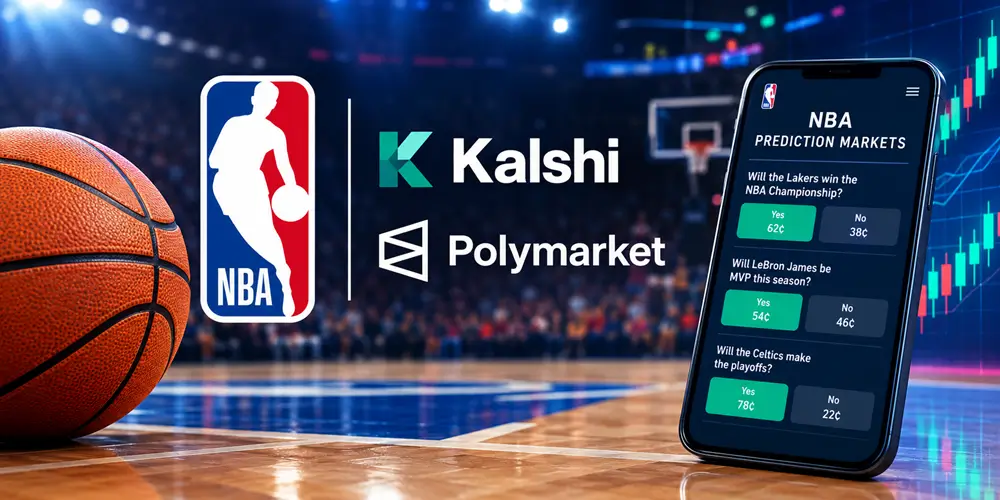
The NBA named Kalshi and Polymarket its preferred prediction market exchanges on October 26, 2026. The NBA Kalshi partnership and a matching Polymarket deal bring official league data and NBA branding to both platforms. They also give the league a say over which NBA prediction markets the exchanges can list.
Fact checked by Paige Williams
Editorial Statement: At CasinoUS, we independently review and select the online casinos featured on our site. We assess each operator using consistent criteria covering licensing, security, payments, payouts, bonuses, games, customer support and responsible gambling.
We may earn commissions when readers use certain affiliate links. However, commercial relationships do not determine which casinos we feature or how we evaluate them. We highlight both strengths and limitations so that US players can make more informed decisions.
That does not make sports event contracts legal for every US bettor. Federal courts disagree on whether states can regulate these products. New Jersey has now asked the Supreme Court to settle it. This guide covers what the deals include, how event contracts work and what to check first.
NBA prediction markets now run under a league framework, but the biggest legal questions are still open.
The NBA announced commercial and integrity agreements with both exchanges on Monday, October 26. Under the deals, ESPN reports that Kalshi and Polymarket each receive:
The league also signed a memorandum of understanding (MOU) with the Commodity Futures Trading Commission (CFTC). An MOU is a formal cooperation agreement, not a law or a license. CFTC Chair Michael Selig welcomed the agreement, according to The Hill.
Public reporting has not disclosed financial terms or the length of either agreement. Coverage so far describes both deals with the same core terms, and neither company has detailed any differences.
The NBA follows the NHL and Major League Baseball, which already partner with both exchanges. Both exchanges already listed NBA markets before Monday, NBC Sports notes.
A prediction market lets you buy and sell event contracts tied to a yes-or-no outcome. Each contract trades between 1¢ and 99¢. It settles at $1 if the outcome happens and $0 if it doesn’t.
The price works as an implied probability. A contract priced at 60¢ suggests the market sees roughly a 60% chance of a “yes” result. For example, 10 contracts at 60¢ cost $6 and pay $10 if the team wins, before fees.
You can also sell contracts before the game ends, provided another trader will buy them. A sportsbook works differently. It sets the odds, takes the other side of your bet and builds its margin (the vig) into the price.
| Feature | Prediction market contract | Sportsbook wager |
| Who sets the price | Buy and sell orders from traders | The sportsbook’s odds |
| Price format | 1¢–99¢, pays $1 if correct | American odds, such as -110 |
| How the operator earns | Trading fees | Margin (vig) built into odds |
| Exiting early | Sell if a buyer exists | Cash out only if offered |
| Main regulator | CFTC, disputed by many states | State gaming regulator |
| Availability | Varies by state and court rulings | States with legal sports betting only |
Fees vary by platform. Kalshi’s fee schedule filed with the CFTC sets a trading fee that changes with the contract price. Check each platform’s current schedule before you trade. The bid-ask spread (the gap between buy and sell prices) adds another cost.
If you already bet through state-licensed sportsbooks, our basketball betting guide explains how standard NBA odds work.
DraftKings is the only sportsbook operator named in Monday’s announcement. The NBA expanded its existing DraftKings agreement to cover the company’s prediction market product, ESPN reports. A DraftKings spokesperson said the deal helps it reach eligible customers around NBA event contracts.
Associated Press reporting says the league is expanding deals with current betting partners to include their prediction products. FanDuel was not part of Monday’s announcement.
Our analysis: the partnerships do not hand any operator an automatic edge. Sportsbooks hold state licenses and can only take bets where sports betting is legal. Prediction markets currently operate nationwide under looser federal rules, AFP reports.
That gap shapes the competition. NBA branding may help exchanges market to fans in states without legal sportsbooks. However, their national model carries more legal risk, while operators like DraftKings now run both products. Our DraftKings Sportsbook review covers its state-licensed product, which depends on where you live.
The NBA says the agreements create an integrity framework for its partner exchanges. According to AFP, the deals include three main safeguards:
The league’s statement called protecting the integrity of the game its “top priority.” Earlier in October, the NBA told sportsbooks to drop some bets, such as the opening tip and certain player unders. AP reporting says the new deals are expected to carry similar limits.
The exact list of restricted NBA markets has not been published. These are also contract terms, so they bind only the partner exchanges.
Monitoring and detection mean watching trades and flagging patterns that suggest manipulation. Prevention means stopping misconduct before it happens, and the deals’ effect there is untested.
Kaufman-Ross also told ESPN the contracts plan for a scenario where the exchanges can no longer offer sports markets.
Sports prediction markets sit in a legal gray zone that courts have not settled. The answer depends on your state, the product and pending court decisions.
Kalshi and Polymarket say their US exchanges are regulated by the CFTC under the Commodity Exchange Act. They argue federal law covers their event contracts and overrides state gambling laws. Lawyers call this federal preemption.
Many states say a contract on a game’s result is simply a sports bet. Under that view, operators need a state license, just like a sportsbook. A bipartisan group of 39 states and Washington, D.C., backed New Jersey’s position, The Hill reports.
Federal appeals courts have reached opposite conclusions on early-stage requests. Here are the key dates:
ESPN reports the Supreme Court is expected to decide in the coming months whether to hear the case. The NFL filed a brief supporting New Jersey. The NBA will not weigh in, and Kaufman-Ross said, “We’ll let the courts decide.”
This is general information, not legal advice. Our guide to US gambling laws explains how state rules apply to sportsbooks and casinos.
Check these points before you trade any sports event contract:
Prediction markets are not a safer or guaranteed alternative to sportsbooks. Set limits before you trade, and use responsible gambling tools if betting stops feeling fun. Free, confidential help is available 24/7 at 1-800-GAMBLER.
Several decisions could reshape sports prediction markets over the next few months. Here’s what to watch:
Our analysis: a Supreme Court ruling for the states could shrink where sports contracts are offered. We also covered ProphetX’s approval as a US prediction market earlier this year.
NBA prediction markets are exchanges where you trade yes-or-no contracts on NBA outcomes, such as a game winner. Since October 26, 2026, Kalshi and Polymarket are the league’s preferred exchanges. Both use official NBA data and must follow league limits on which markets they list.
The NBA says the deals give it more control over integrity. It can now limit which NBA markets are offered and receive information about suspicious trading. In return, both exchanges gain official data and branding rights. NBA executive Scott Kaufman-Ross told ESPN the league waited until the right regulatory framework was in place.
No. Kalshi and Polymarket describe themselves as CFTC-regulated exchanges, not state-licensed sportsbooks. You trade contracts with other users instead of betting against the house. Several states disagree, arguing sports contracts are bets that need a state license. Federal appeals courts have split on that question.
Many can, but not everywhere. Access depends on your state, each platform’s rules and ongoing court cases. Recent Sixth and Ninth Circuit rulings let some states enforce gambling laws against Kalshi. Check each platform’s eligibility rules and your state’s position before opening an account.
No single answer covers all 50 states as of October 27, 2026. The CFTC oversees the exchanges, but many states say sports contracts break their gambling laws. New Jersey has asked the Supreme Court to decide who has authority. Until then, legality can differ by state and by court ruling.
Nobody can say yet. DraftKings now runs a prediction product alongside its state-licensed sportsbook. For now, the two models overlap. Court rulings will decide how far exchanges can expand.
The NBA has named Kalshi and Polymarket its preferred exchanges. It also signed a CFTC memorandum and added integrity terms to both deals.
The financial terms and the list of restricted markets remain unknown. So does the central question of whether states can regulate sports contracts. Watch the Supreme Court’s response to New Jersey, because it could change where these products are available.
 Alex Harper • 10 min
read
 Alex Harper • 10 min
read
 Alex Harper • 10 min
read
 Alex Harper • Oct 26, 2026
 Lara Johns • Oct 26, 2026
 Alex Harper • Oct 22, 2026
 Alex Harper • Oct 22, 2026