Macquarie Q3 Forecast: What It Means for US Sports Bettors
 Alex Harper • Oct 8, 2026


Editorial Statement: At CasinoUS, we independently review and select the online casinos featured on our site. We assess each operator using consistent criteria covering licensing, security, payments, payouts, bonuses, games, customer support and responsible gambling.
We may earn commissions when readers use certain affiliate links. However, commercial relationships do not determine which casinos we feature or how we evaluate them. We highlight both strengths and limitations so that US players can make more informed decisions.
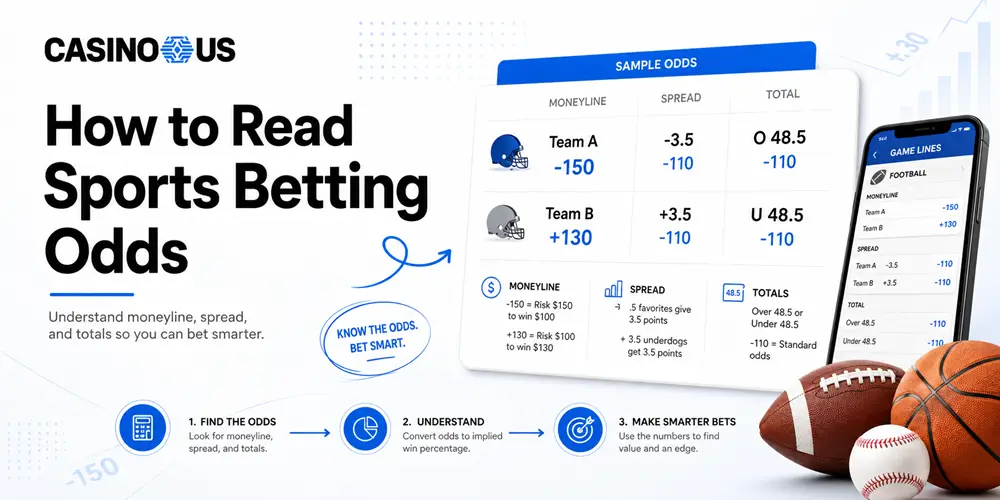
Sports betting odds tell you two things. First, how likely a sportsbook thinks something will happen. Second, how much money you can win if you’re right. In the US, odds almost always show up in American format. That means numbers like -150 or +130. Once you learn how to read them, you can compare any two bets in seconds. This guide explains American odds, shows you how to turn them into a win percentage, and covers how odds work for moneylines, spreads, and totals.
American odds are built around $100. The plus or minus sign tells you which side of that number you’re on. A minus sign (-150) means the team is the favorite. The number shows how much you need to bet to win $100 in profit. Bet $150 on a -150 favorite. If you win, you get $100 in profit. Your total return is $250.
A plus sign (+130) means the team is the underdog. The number shows how much profit you win on a $100 bet. Bet $100 on a +130 underdog. If you win, you get $130 in profit. Your total return is $230.
Favorites always have a minus sign. Sportsbooks think they’ll win more often, so you have to risk more money to win the same $100. Underdogs have a plus sign. They’re less likely to win, so the payout is bigger compared to what you risk.
Every set of odds hints at a win percentage. This is the sportsbook’s guess at how likely that outcome is. Knowing this number helps you judge if a bet is actually a good deal.
For odds with a minus sign, follow these steps:
Example: -150 odds. Divide 150 by 250 (150 + 100). That gives you 0.60. Multiply by 100. The win percentage is 60%.
For odds with a plus sign, follow these steps:
Example: +130 odds. Divide 100 by 230 (130 + 100). That gives you about 0.435. Multiply by 100. The win percentage is about 43.5%.
Add up the win percentages for both sides of a bet. The total usually comes out above 100%. That extra bit is the sportsbook’s built-in fee. Bettors call this the “vig” or “juice.” It’s how sportsbooks make money no matter who wins.
American odds show up in three main types of bets. The number means something a little different in each one.
Moneyline bets are a simple pick on who wins the game. There’s no point spread involved. The odds show how big the gap is between the two teams. A big mismatch means big numbers, like -400 for the favorite and +320 for the underdog.
Spread bets add a point handicap to the game. The odds on each side are usually close to even, often between -105 and -120. That’s because the point spread is designed to make both sides equally likely to win. You’re not just picking the winner. You’re picking whether the favorite wins by more than the spread, or the underdog loses by less than the spread.
Total bets, also called over/under bets, work like spread bets. You’re betting on whether the two teams’ combined score goes over or under a set number. Each side usually has odds close to -110.
American odds are the standard at US sportsbooks. But you might run into decimal or fractional odds too. Some sportsbook apps let you switch the odds format in the settings. Offshore or international sites often use decimal or fractional odds by default.
Decimal odds show your total return for every $1 you bet, including your original stake. A decimal of 2.50 means a $100 bet returns $250 total. That’s $150 in profit plus your original $100 back. To turn decimal odds into American odds: if the decimal is 2.00 or higher, subtract 1 and multiply by 100. If it’s under 2.00, divide -100 by the decimal minus 1.
Fractional odds are common at UK and Irish sportsbooks. They show profit compared to your stake, written as a fraction. Odds of 5/2 mean a $2 bet profits $5. Your total return would be $7. A fraction like 10/11 is a near-even bet, similar to -110 in American odds.
Here’s how the same three odds look in each format:
| American | Decimal | Fractional | Implied Probability |
| -150 | 1.67 | 2/3 | 60% |
| +130 | 2.30 | 13/10 | ~43.5% |
| -110 | 1.91 | 10/11 | ~52.4% |
You don’t have to memorize these conversions. Most sportsbook apps and odds calculators do the math for you. Just remember that all three formats show the same price in a different way. A -150 favorite, 1.67 decimal odds, and 2/3 fractional odds all pay out the same amount.
Most sportsbook apps show all three bet types side by side for one game. A typical NFL listing might show a favorite at -7.5 (-110) on the spread, -320 on the moneyline, and the total at 44.5 with -110 on both sides. The spread and total odds sit next to the point number. The moneyline number stands alone since it’s just a pick on the winner.
Odds also change between when a game is first posted and when it kicks off. Injury news, lineup changes, and heavy betting on one side can all move the line. Check the odds close to game time to see the most current number. Early lines are more likely to shift.
Every sportsbook sets its own odds. That means the same game can have different odds at different sportsbooks. This is called line shopping. A favorite might be -150 at one book and -140 at another for the exact same game. That small gap can change your payout. Bettors who compare odds across a few licensed, legal sportsbooks in their state tend to get better value over time than those who stick to just one book.
Reading odds helps you make smarter choices. It doesn’t guarantee a win. No formula can predict the future, and a win percentage is just the sportsbook’s pricing, not a sure thing. Set a budget before you bet. Think of that money as the cost of fun, not a way to make income. Stop if betting stops being fun. If you or someone you know is struggling with gambling, help is available 24/7. Call or text 1-800-MY-RESET to reach the National Problem Gambling Helpline.
Lara Johns • 10 min
read
 Alex Harper • 10 min
read
Alex Harper • 10 min
read
 Alex Harper • 10 min
read
Alex Harper • 10 min
read
 Alex Harper • Oct 8, 2026
  Alex Harper • Oct 7, 2026
  Alex Harper • Oct 6, 2026
  Alex Harper • Oct 6, 2026
 Editorial Statement: Casino US is your trusted source for timely industry updates, in-depth analysis, and honest operator reviews. Our editorial team brings years of specialized gaming industry knowledge to every story, holding ourselves to strict standards of accuracy and objectivity. We're dedicated to providing straightforward, unbiased, and reliable reporting on the US gambling landscape and beyond.