Rugby History Was Made in Baltimore: Why the Springboks’ Record Just Got Bigger for American Fans
 Lara Johns • Sep 14, 2026
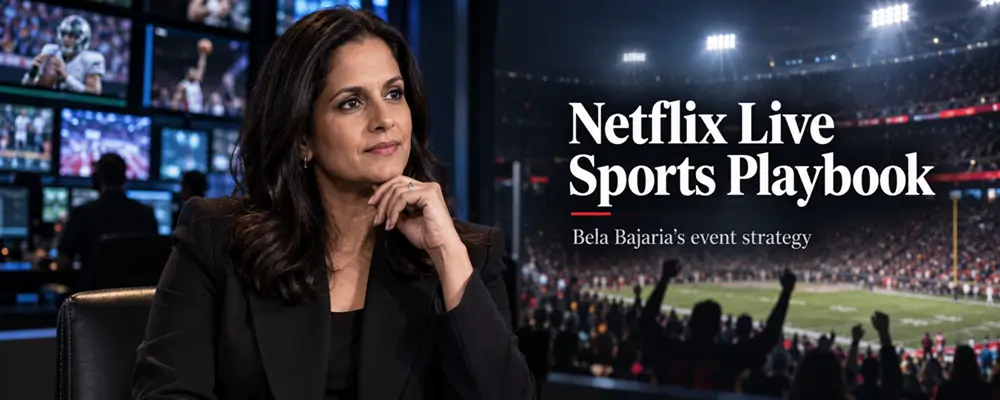

Netflix isn’t trying to out-bid every network for every sports package on the market. According to Chief Content Officer Bela Bajaria, the company is chasing something narrower: moments big enough to feel unmissable.
In an interview with CNBC Sport, Bajaria laid out how Netflix decides which live sports and events are worth its money. Her answer wasn’t about volume of games or hours of programming. It was about cultural weight: whether a broadcast can pull in casual viewers who wouldn’t otherwise tune in, and get people talking about it afterward.
That framing matters right now. Netflix has already reshaped its Christmas Day NFL games into an annual tradition, is expanding into international matchups, and has floated interest in soccer’s biggest stage. Here’s what Bajaria said, what it tells us about Netflix’s next moves, and why sports bettors should be paying attention.
Bajaria described Netflix’s target as something that feels culturally urgent rather than just another game on the schedule. In her words, an event needs to carry a “fuzzy, cultural, zeitgeist” quality: the kind of moment that just feels like it’s very appointment TV, but also with great conversation around it.
That’s a different filter than the one traditional broadcasters use. A network with a 17-week NFL package needs every Sunday filled. Netflix, by contrast, can be selective, picking a handful of dates each year where it believes the audience will show up in huge numbers and the internet will be buzzing about it the next morning.
Asked directly whether a weekly package like NBC’s “Sunday Night Football” would meet Netflix’s definition of an event, Bajaria pointed out that regular, recurring inventory isn’t really what the company is chasing; the target is the standout occasion, not the weekly habit.
This selectivity is deliberate. Netflix built its business on on-demand viewing: watch what you want, whenever you want. Live sports works against that model in some ways, since it demands appointment viewing and can’t be binged later without losing its value.
Rather than fight that tension by loading up on every available rights package, Netflix appears to be using live sports as a promotional and retention tool: a handful of massive audience spikes per year, rather than a constant stream of games competing with traditional sports networks on their own turf.
That strategy also keeps costs more contained than a full-season sports package would. Netflix reportedly operates with a content budget in the tens of billions of dollars, and dedicating a meaningful slice of that to year-round sports rights would be a very different bet than a handful of high-profile specials.
The NFL is the clearest proof of concept for Bajaria’s philosophy. Netflix’s relationship with the league started with two exclusive Christmas Day games in 2024, a deal that quickly validated the model: last year’s Christmas Day broadcast became the most-streamed NFL regular season game in US history.
Netflix has since expanded that footprint. For the 2026 season, the streamer is carrying five NFL events: the league’s first-ever regular-season game played in Australia, a new Thanksgiving Eve matchup between the Packers and Rams, two Christmas Day games, a Week 18 game in January, and NFL Honors during Super Bowl week. Netflix and the NFL extended their partnership through 2029, locking in the holiday windows along with the newly added dates.
Notably, none of this touches the NFL’s core weekly inventory, which remains split across Fox, CBS, NBC, ESPN, Amazon and Peacock. Netflix picked the calendar’s highest-attention days instead, the ones built to draw viewers who don’t watch football every week.
Bajaria also signaled Netflix wouldn’t rule out more. She said the company would be open to bidding on an international NFL package if one becomes available when the league revisits its media rights agreements, though she was clear that Netflix’s US subscriber base still wants domestic football too. The NFL holds an opt-out on its current deal structure after the 2029-30 season, which is the next realistic window for a broader shakeup.
Football isn’t the only sport on Netflix’s radar. The company already holds US and Canadian rights to the 2027 and 2031 FIFA Women’s World Cups, and Bajaria confirmed Netflix’s interest in eventually bidding for the men’s tournament in 2030 and 2034, deals that would put Netflix in direct competition with the broadcasters that have carried the men’s World Cup for decades.
Netflix’s live-event résumé outside football is already substantial: WWE programming, boxing and combat sports (including the record-breaking Tyson-Paul fight), Formula 1’s Netflix Cup exhibition, and one-off specials and awards shows. Each fits the same pattern Bajaria described: a date circled on the calendar rather than a recurring weekly commitment.
Bajaria also addressed how Netflix might work with other platforms rather than always competing head-on. She pointed to Netflix’s arrangement with France’s TF1 Group, which she called an early test of embedding another company’s live content inside Netflix, as a model that could expand. That comment came against the backdrop of YouTube’s move to ingest NBCUniversal’s Peacock content into YouTube Premium, a sign that streamers are increasingly willing to distribute each other’s programming rather than only bidding against one another for exclusive rights.
Netflix’s approach adds to a broader shift already underway: sports rights are fragmenting across more platforms than ever, with YouTube, Amazon, Apple and Netflix all now competing alongside traditional broadcasters for at least a piece of major leagues’ inventory.
For viewers, that fragmentation cuts both ways. Marquee events are increasingly available without a cable subscription, but keeping up with a full season across multiple streaming services has become more complicated and, in some cases, more expensive. Netflix’s model, a handful of huge dates rather than a season-long commitment, sidesteps some of that complexity for casual viewers while still requiring a subscription to watch.
Netflix has not announced any move into sportsbook operations or wagering products, and nothing Bajaria said in the CNBC interview suggests that’s part of the company’s plans. Any claim to the contrary would be speculation, not reporting.
That said, the broader dynamic Bajaria described, concentrating attention around a small number of unmissable live events, is relevant to the legal US sports betting market in a conceptual sense. Live, appointment-viewing sports have historically driven spikes in betting activity, since audiences tend to bet more heavily around nationally televised, high-profile matchups than around routine games. Netflix’s Christmas Day NFL doubleheader and its Thanksgiving Eve game fall into exactly that category: high-visibility, high-attention windows where casual sports fans, not just regular bettors, are watching.
Whether Netflix’s specific broadcasts move betting handle at licensed sportsbooks isn’t something Netflix, the NFL, or independent researchers have published data on. What is reasonable to say is that as more “event”-style sports migrate to platforms like Netflix, sportsbooks and media partners will likely continue adjusting their marketing and promotional pushes around those dates, the same way they already do around Super Bowl Sunday or March Madness.
A few threads from Bajaria’s comments are worth tracking heading into 2027 and beyond:
None of these are confirmed deals. They’re extensions of a strategy Bajaria has now explained fairly directly: Netflix wants the moments that dominate the cultural conversation, not a full season’s worth of inventory.
Netflix focuses on a small number of high-profile “event” broadcasts, games, or occasions it believes carry major cultural weight, rather than acquiring full-season sports packages.
Netflix is streaming five NFL events in 2026: the Australia opener, a Thanksgiving Eve game, two Christmas Day games, a Week 18 game, and NFL Honors during Super Bowl week.
Bajaria describes an event as a culturally significant, appointment-viewing moment that generates conversation, rather than a routine, recurring broadcast.
Bajaria confirmed Netflix’s interest in potentially bidding on the 2030 and 2034 FIFA Men’s World Cup and said Netflix would consider an international NFL package if one becomes available. Neither is a confirmed deal.
Netflix has not announced any sportsbook or betting product. Its high-visibility broadcasts, like the Christmas Day NFL games, fall into the kind of nationally watched events that have historically coincided with increased betting attention, though no data ties Netflix broadcasts specifically to betting handle.
No. Netflix’s NFL rights are limited to specific dates, holidays, international games, and select regular-season windows, while weekly coverage remains with traditional broadcasters and other streamers.

 Alex Harper • 10 min
read
Alex Harper • 10 min
read
 Lara Johns • 10 min
read
Lara Johns • 10 min
read
 Lara Johns • 10 min
read
Lara Johns • 10 min
read
 Lara Johns • Sep 14, 2026
  Lara Johns • Sep 11, 2026
  Alex Harper • Sep 9, 2026
  Alex Harper • Sep 8, 2026
 Editorial Statement: Casino US is your trusted source for timely industry updates, in-depth analysis, and honest operator reviews. Our editorial team brings years of specialized gaming industry knowledge to every story, holding ourselves to strict standards of accuracy and objectivity. We're dedicated to providing straightforward, unbiased, and reliable reporting on the US gambling landscape and beyond.