The Gambling Talk: How to Start It With Your Kids in 2026
 Alex Harper • Oct 22, 2026
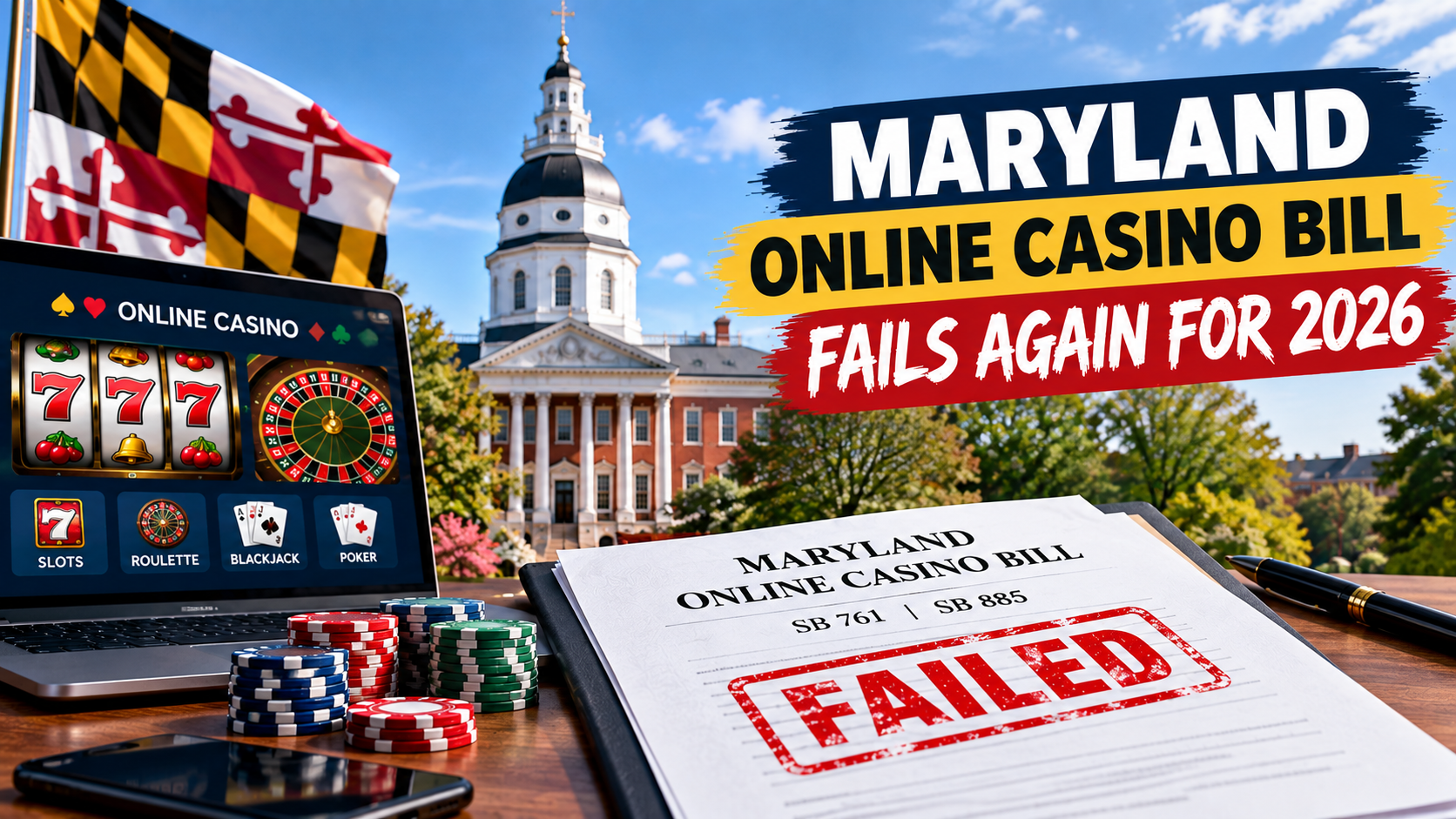
A Maryland online casino bill is off the table again this year. That question will not appear on the November ballot. Lawmakers closed out the 2026 legislative session without moving the bill forward.
Fact checked by Dave Cooper
Editorial Statement: At CasinoUS, we independently review and select the online casinos featured on our site. We assess each operator using consistent criteria covering licensing, security, payments, payouts, bonuses, games, customer support and responsible gambling.
We may earn commissions when readers use certain affiliate links. However, commercial relationships do not determine which casinos we feature or how we evaluate them. We highlight both strengths and limitations so that US players can make more informed decisions.
A pair of connected bills carried the push this year. SB 761 sought to bring the legalization question directly to voters. SB 885 laid out what a regulated online casino and bingo system would look like. Both had to pass together, and neither made it.
SB 761 had a hearing scheduled at the Senate Budget and Taxation Committee for March 10. That hearing never happened. Senator Ron Watson, the bill’s sponsor, pulled it three days later.
Once SB 761 fell through, SB 885 lacked a referendum to pair with. The bill’s committee hearing landed March 11. The bill missed the March 23 cutoff for advancing out of its chamber. Lawmakers adjourned April 13 without passing either bill.
Maryland’s retail casino operators opposed the expansion from the start. Cordish Companies runs the Live! Casino property, while PENN Entertainment operates Hollywood Casino, and both companies pushed back hard. Both said the change would siphon players and revenue away from their physical floors.
Their case: the tax revenue gained would not offset what retail casinos would lose. That argument carries weight with lawmakers. Maryland’s retail sportsbooks opened their doors in December 2021, with mobile wagering arriving not long after.
The state’s sports betting tax haul sits at about $140 million since betting went live. Backers wanted a similar boost from legal online casino gambling.
Lawmakers cited an estimate of $7 billion annually in Maryland offshore casino spending during committee hearings. The figure’s underlying methodology has not been made public.
Had it passed, Maryland online casino licensing would have gone to the State Lottery and Gaming Control Commission. The six current casino operators would not have held a monopoly on licenses.
Sports wagering facilities, video lottery terminal operators, and Maryland-based businesses could have competed for a license too. Some of those spots would have been reserved for social equity applicants.
SB 885 skipped a flat tax in favor of a revenue-sharing structure. Operators would have kept 80% of what live dealer tables brought in and 60% of everything else. The state would have used the rest for regulation, education, and responsible gambling work.
License holders would have needed labor peace agreements first. A carve-out set aside as much as $10 million in year-one proceeds to help casino employees affected by the change. The rules also would have kept credit cards out of the deposit process and pointed players toward responsible gambling help.
None of it took effect. Opposition from the state’s largest casino operators, plus the referendum bill’s failure, kept the framework from moving forward.
Legalizing online casino games was not the only gambling issue left unresolved. Two bills aimed at sweepstakes casinos, HB 295 and HB 1226, cleared the House of Delegates. Both stalled in the Senate Budget and Taxation Committee.
HB 295 targeted dual-currency games that resemble real-money casino play. HB 1226 is officially known as the Maryland Illegal Online Gambling Enforcement Act.
It would have given regulators stronger tools to penalize illegal operators and the affiliates who promote them. Neither bill advanced before lawmakers adjourned, so sweepstakes casinos continue to operate in Maryland without state oversight.
Maryland residents still have access to a licensed retail casino, plus sports betting both in person and on mobile apps. Maryland has no licensed path for real-money slots or table games online. That will not change before the next legislative session.
While Maryland waits, the list of states legalizing online casinos keeps growing. A handful of neighboring markets already offer regulated real-money slots and table games online.
Maryland online casino advocates will have to wait, with no clear timeline for a comeback. Maryland lawmakers return to Annapolis for the next session in January. Whether the two bills come back in similar form remains an open question. Until then, check our US gambling laws guide for where every state stands.
 Alex Harper • 10 min
read
Alex Harper • 10 min
read
 Alex Harper • 10 min
read
Alex Harper • 10 min
read
 Lara Johns • 10 min
read
Lara Johns • 10 min
read
 Alex Harper • Oct 22, 2026
  Alex Harper • Oct 22, 2026
  Alex Harper • Oct 21, 2026
  Alex Harper • Oct 21, 2026