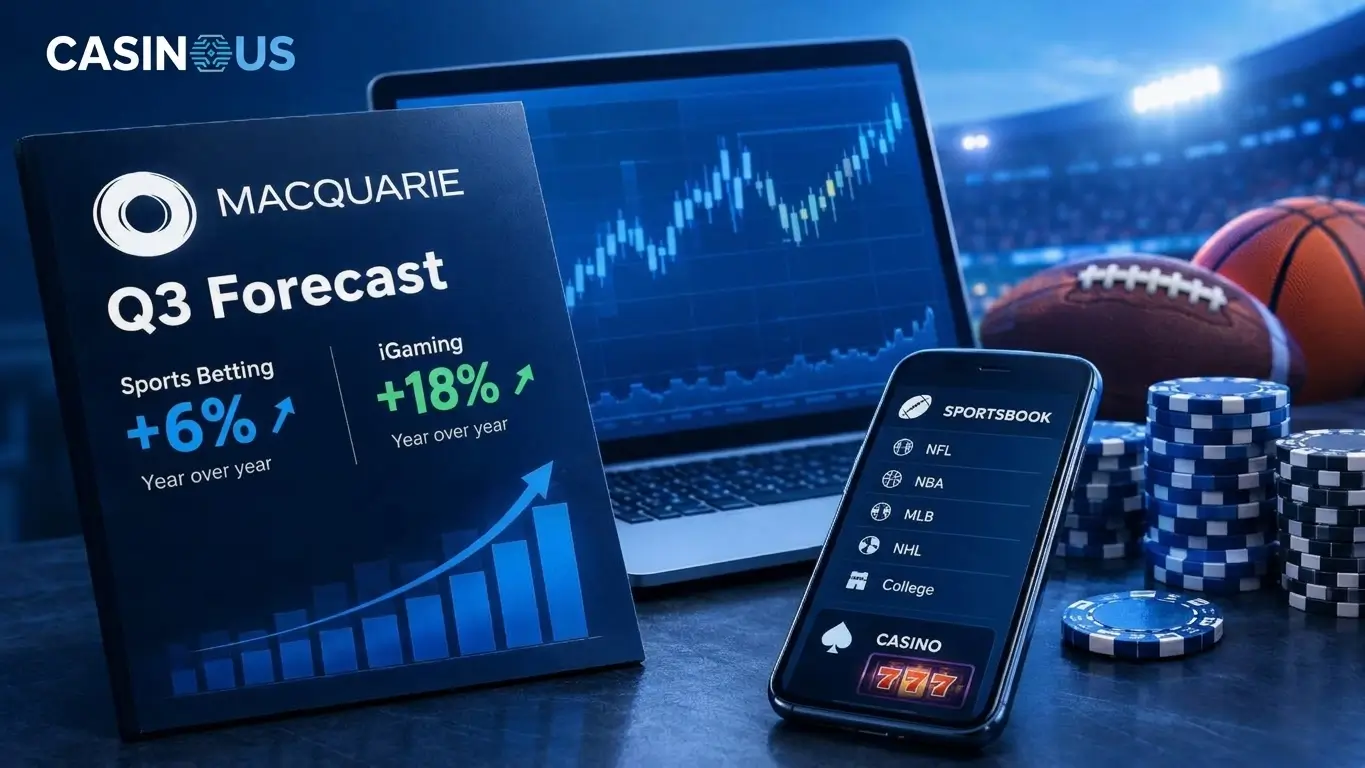
Macquarie Q3 Forecast: What It Means for US Sports Bettors
 Alex Harper • Oct 8, 2026


Editorial Statement: At CasinoUS, we independently review and select the online casinos featured on our site. We assess each operator using consistent criteria covering licensing, security, payments, payouts, bonuses, games, customer support and responsible gambling.
We may earn commissions when readers use certain affiliate links. However, commercial relationships do not determine which casinos we feature or how we evaluate them. We highlight both strengths and limitations so that US players can make more informed decisions.

LeBron James signed with the Philadelphia 76ers in July 2026, and it blindsided the biggest single-athlete prediction market Kalshi has ever run. Traders had priced the 76ers at roughly 9% just before the announcement, well behind the Cleveland Cavaliers, Miami Heat, and Golden State Warriors. Then the price moved fast, and money followed it. What happened in the minutes around that trade shows exactly how betting on news works on platforms like Kalshi, and why speed, not sports knowledge, decides who profits.
James’s free agency turned into the biggest sports market Kalshi had listed outside of the Super Bowl. More than $230 million was traded on his next destination, making it one of the platform’s ten largest markets in its history. Across all prediction-market platforms combined, over $250 million rode on where James would sign next.
The board shifted for weeks. Cleveland led from July 2 through mid-July. Golden State spiked to nearly 42% on June 30 before sliding back under 20%. Miami overtook the top spot on July 18. By the Thursday night before James announced his decision, Philadelphia sat at just 8.7%, treated by traders as an afterthought.
James signed with the 76ers anyway, more than doubling Philadelphia’s NBA championship odds overnight and leaving a nine-figure market on the wrong side of the biggest free-agency call in years.
Kalshi’s own data shows Philadelphia’s implied odds jumping to 77% roughly 20 minutes before ESPN insider Shams Charania broke the news publicly. A Kalshi spokesperson later said the platform’s minute-by-minute price chart runs through a “smoothing algorithm” that can make trading activity appear to have happened earlier or later than it actually did. The company says the real spike landed at 11:27 or 11:28 a.m. ET, still ahead of the public announcement, but less dramatic than the chart made it look.
That gap between a price move and a confirmed headline is where the profit lives. Someone traded Philadelphia contracts while the market still treated the 76ers as a long shot, and got paid when the rest of the field caught up.
The NBA has told federal regulators this is precisely the kind of market that should not exist. James, a small circle of family, agents, and team executives decided the outcome. A far larger group, including assistants, communications staff, and reporters, had a chance to learn it first. Any one of them trading ahead of the news would look a lot like insider trading on a Wall Street exchange, except Kalshi’s contracts fall under Commodity Futures Trading Commission oversight rather than state gambling regulation.
That distinction matters. On a licensed sportsbook, odds come from the operator and a bettor can’t move the line by trading on non-public information. On an exchange-style market like Kalshi, traders are betting against each other, and someone trading on early knowledge of James’s decision would have been taking money directly from every trader still holding the wrong side of the contract.
Kalshi runs a public REST API and a real-time WebSocket feed built for automated trading. Bots connected to that feed can see order book changes and place trades in milliseconds, far faster than a person can refresh a page and click buy. That infrastructure is built for legitimate strategies like market making and statistical arbitrage, but it also means that whoever reacts fastest to a price move, not whoever has the best read on where a star player signs, usually wins the trade.
This is the core mechanic behind every fast-moving Kalshi market, not just the LeBron trade. When a market is tied to a single confirmable event, like an announcement, a data release, or a verdict, the payout goes to whoever’s system reacts first once the outcome becomes knowable. A retail bettor watching the app is almost never that person.
Not exactly. Kalshi lists event contracts that settle at $1 if an outcome happens and $0 if it doesn’t, and it operates as a CFTC-regulated exchange rather than a state-licensed sportsbook. That structure is why Kalshi can offer contracts in states where online sports betting is otherwise illegal, a point that has drawn legal challenges from casino operators, tribal gaming interests, and several state regulators who argue the platform is offering sports betting under a different label.
For a player, the financial risk is the same either way. Money placed on an outcome can be lost in full, and no amount of research changes that a news-driven market can move before the public even knows why.
A fast-moving price on a news market is not confirmation of anything. Keep a few things in mind before treating a sudden swing as a signal:
None of this makes prediction markets, sports betting, or casino gaming a reliable way to make money. Outcomes are never guaranteed, and the fastest system in the room usually captures the edge before anyone else even sees the opportunity.
Gambling involves financial risk. Only wager what you can afford to lose, and remember that gambling laws and market availability vary by state. If gambling stops being fun or starts to feel out of control, help is available 24/7 through the National Council on Problem Gambling at 1-800-GAMBLER.
Kalshi ran a prediction market on where LeBron James would sign in free agency. Traders priced the Philadelphia 76ers at under 10% right up until his announcement. He signed with Philadelphia anyway, upending a market with more than $230 million in trading volume.
Kalshi’s own price chart shows Philadelphia’s odds spiking roughly 20 minutes before the news became public, though the company says its display can make trades appear earlier or later than when they actually happened. The NBA has raised insider-trading concerns about markets tied to information held by a small circle of people close to a player.
Kalshi operates as a CFTC-regulated exchange and argues that status lets it offer contracts nationwide, including in states without legal online sports betting. Several states and gaming operators dispute that position, and the legal fight over Kalshi’s status is ongoing.
Not on speed. Kalshi supports automated trading through a public API and WebSocket feed, letting bots react to price changes in milliseconds. A person manually placing trades is almost always slower than an automated system watching the same market.
They’re structured differently. Prediction markets like Kalshi list event contracts that settle at $0 or $1 based on an outcome, and traders bet against each other rather than against a sportsbook’s odds. The financial risk to the player is comparable either way.
Contact the National Council on Problem Gambling at 1-800-GAMBLER for free, confidential support available across the United States.
Lara Johns • 10 min
read
 Alex Harper • 10 min
read
Alex Harper • 10 min
read
 Alex Harper • 10 min
read
Alex Harper • 10 min
read
 Alex Harper • Oct 8, 2026
  Alex Harper • Oct 7, 2026
  Alex Harper • Oct 6, 2026
  Alex Harper • Oct 6, 2026
 Editorial Statement: Casino US is your trusted source for timely industry updates, in-depth analysis, and honest operator reviews. Our editorial team brings years of specialized gaming industry knowledge to every story, holding ourselves to strict standards of accuracy and objectivity. We're dedicated to providing straightforward, unbiased, and reliable reporting on the US gambling landscape and beyond.