Sports Betting Advertising May Reach $7 Billion in 2027
 Alex Harper • Oct 19, 2026
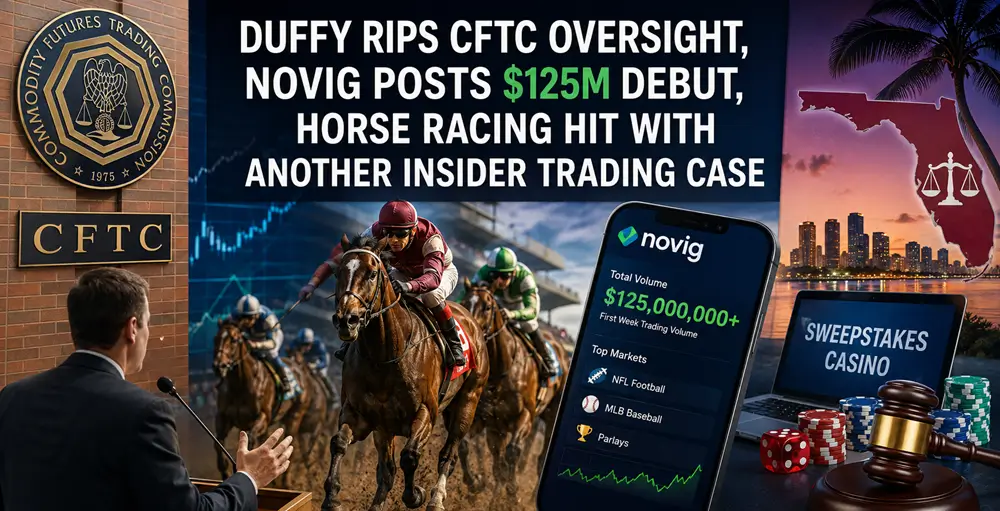
CME Group CEO Terry Duffy publicly criticized the Commodity Futures Trading Commission’s oversight of prediction markets this week, telling the agency’s new advisory committee that unchecked contract approvals are hurting the industry. The comments came during a week that also brought a fast start for prediction market newcomer Novig, a second insider trading case tied to horse racing, and a Florida lawsuit against sweepstakes casino operators. Here is what these developments mean for US bettors and casino players following the sports betting and prediction market space heading into football season.
Fact checked by Paige Williams
Editorial Statement: At CasinoUS, we independently review and select the online casinos featured on our site. We assess each operator using consistent criteria covering licensing, security, payments, payouts, bonuses, games, customer support and responsible gambling.
We may earn commissions when readers use certain affiliate links. However, commercial relationships do not determine which casinos we feature or how we evaluate them. We highlight both strengths and limitations so that US players can make more informed decisions.
Terry Duffy criticized the CFTC’s handling of prediction market contracts during the agency’s first Innovation Advisory Committee meeting on Thursday, August 20, arguing that regulators have let too many risky contracts through without proper review.
Duffy pointed out that the CFTC has not rejected any of the more than 2,500 self-certified contracts filed over the past two years. That list includes the Trump-mention markets that the president’s former teleprompter operator profited from, along with several player prop-style sports contracts that critics say resemble traditional sports betting more than financial hedging tools.
“This is not good for our industry. It’s horrible for our industry. We are not a bunch of carnival barkers at a circus,” Duffy said at the meeting.
CFTC Chair Mike Selig and Kalshi co-founder Luana Lopes Lara pushed back on Duffy’s characterization, and the discussion turned into a pointed exchange between Duffy and Lara. The clash highlights a growing rift between traditional derivatives exchanges and the newer prediction market platforms that have expanded rapidly into sports outcomes over the past two years.
Horse racing integrity is back in the headlines. After suspicious bets were cashed on suspiciously won races at Saratoga and Monmouth Park earlier this month, the Horseracing Integrity and Safety Authority (HISA) brought fraud and data access charges against Marshall Gramm, a respected horse player, owner, and college economics professor.
HISA maintains a database of racehorse health records that only a horse’s primary owner, HISA-approved veterinarians, and state racing regulators can access. The authority alleges that during six weeks this spring, Gramm accessed records for horses he did not own while competing in handicapping contests and buying horses through claiming races. Customized past performance charts built from that confidential data also turned up on social media.
“Our evidence showed that Mr. Gramm used essentially an automated and invisible browser to download records at scale, while employing methods to avoid detection,” HISA CEO Lisa Lazarus said.
Gramm agreed to a provisional suspension on August 24, one day before HISA’s deadline for his formal response. Under the agreement, he must divest his ownership interests in his horses, cannot claim horses, and cannot go to a racetrack while the case proceeds. He has also returned handicapping contest winnings and said he is working to return purse money. Gramm withdrew from the 2027 National Horseplayers Championship, a $5.5 million contest in Las Vegas, and the National Thoroughbred Racing Association suspended him from future events. The Jockey Club also revoked his membership. HISA’s fraud and data access hearings are scheduled for September 14 and 16, and Gramm still faces a potential lifetime ban depending on the outcome.
Novig posted over $125 million in trading volume during the first week of its prediction market exchange, a total that outpaced the opening-week numbers of Kalshi, Polymarket US, Underdog, and DraftKings’ DKeX. The debut puts Novig at No. 4 among US prediction market operators by volume.
Parlays accounted for roughly a third of the first week’s volume, with baseball driving most of the action during one of the slowest stretches of the US sports calendar. Novig, which shifted its user base over from a sweepstakes platform, expects volume to climb significantly once football season gets underway.
Sweepstakes casinos drew regulatory attention of their own this week. Florida has not passed a law banning the dual-currency platforms, but Attorney General James Uthmeier is suing sweepstakes operators Stake and VGW directly. The lawsuit also names payment processors that work with the two companies, a move aimed at cutting off the flow of money to sweepstakes operators in the state.
Prediction markets keep growing fast, and this week’s news shows the regulatory picture around them is far from settled. Duffy’s comments add a prominent industry voice to concerns about how thoroughly the CFTC vets new contracts, while Novig’s strong debut shows demand for these products remains high heading into football season. On the horse racing side, the Gramm case is a reminder that data protection and access controls matter in any wagering market, and that governing bodies are willing to act when integrity is compromised. Bettors weighing new platforms, whether prediction market exchanges or traditional sportsbooks, should stick to licensed, regulated operators and stay alert to how each platform is overseen in their state.
Sports betting and prediction market trading should stay entertainment, not a source of income. Set a budget before you bet, only wager money you can afford to lose, and avoid chasing losses. If gambling stops feeling fun, free and confidential help is available 24/7 through the National Council on Problem Gambling at 1-800-GAMBLER.
 Lara Johns • 10 min
read
Lara Johns • 10 min
read
 Alex Harper • 10 min
read
Alex Harper • 10 min
read
 Alex Harper • 10 min
read
Alex Harper • 10 min
read
 Alex Harper • Oct 19, 2026
  Alex Harper • Oct 19, 2026
  Lara Johns • Oct 15, 2026
  Alex Harper • Oct 15, 2026