Saracen Casino Executives Face Firing Over GamePhysics
 Alex Harper • Sep 28, 2026
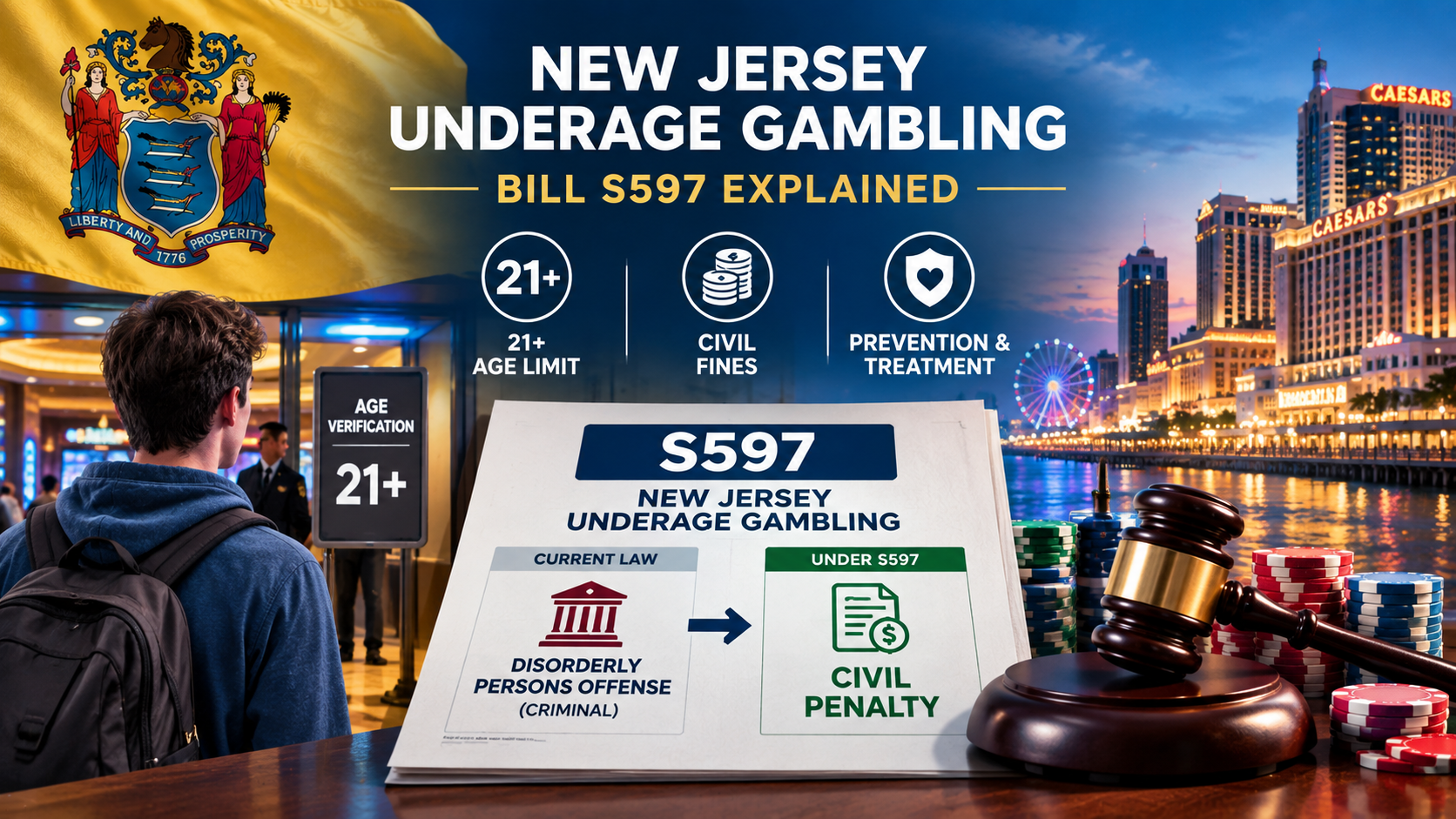

New Jersey underage gambling may soon stop being a crime. Senate Bill 597 would swap criminal charges for civil fines when people younger than 21 bet in a casino.
The gambling age stays at 21, but a young person’s record could stay clean.
Today, a player younger than 21 who bets in Atlantic City risks a disorderly persons charge. New Jersey uses that label for low-level crimes, much like a misdemeanor in other states. Even so, it still leaves a criminal record.
S597 would swap that charge for a civil penalty. Think of it like a traffic ticket: you pay a fine, but you don’t get a criminal record.
| Issue | Current Law | Under S597 |
| Type of offense | Disorderly persons charge (criminal) | Civil penalty |
| Criminal record | Yes | No |
| First offense | $500 to $1,000 | $500 max |
| Second offense | $500 to $1,000 | $1,000 max |
| Third and later offenses | $500 to $1,000 each | $2,000 max each |
| Where it applies | Casinos and simulcast facilities | No change |
S597 covers three groups of people:
Every dollar from these fines would go into the state’s General Fund for its human services agency. That agency would use it to prevent problem gambling, teach the public about the risks and pay for treatment.
Notice the signs of a gambling problem in yourself or a teen? New Jersey offers free, confidential help at 1-800-GAMBLER.
Sen. James Beach (D-Camden) has pushed to reform New Jersey underage gambling penalties for about four years. He first teamed up with Sen. Vincent Polistina (R-Atlantic) on a near-copy, S3972, late in 2024. However, that bill died when the 2024-25 session closed.
The new version returned in January 2026 with support from both parties. Three more senators, John McKeon, Shirley Turner and Kristin Corrado, now back it as co-sponsors.
The state’s Casino Control Act bars anyone younger than 21 from the gaming area. Security teams check IDs at every entrance and scan the tables for guests who look too young.
Still, fake IDs keep improving, and casinos pay a steep price when minors slip through. In 2008, regulators ordered Bally’s to pay a record $157,500 for letting a 20-year-old woman gamble repeatedly.
Staff keep a defense if a minor lied in writing about their age and looked 21. The bill also leaves the rules behind fines like Bally’s untouched.
S597 still has several steps to clear. The Senate first sent it to the State Government, Wagering, Tourism and Historic Preservation Committee in January. On September 28, the Senate’s Judiciary Committee took it over.
It then needs votes in both chambers and the governor’s signature. Lawmakers meet through December 17, but the two-year session lets the bill carry into 2027.
For adults, nothing changes on the casino floor or on legal apps. The bill rewrites New Jersey underage gambling penalties, not the age limit. If you play at legal New Jersey casinos and sportsbooks, you still need to be 21.
In other states, the gambling age limit drops to 18 for some games. Meanwhile, Pennsylvania regulators launched a youth awareness push in 2026, and New York’s governor floated biometric ID checks.
Rules differ everywhere, and US gambling laws on minors vary widely by state.
S597 keeps the 21 age limit but softens the penalty for breaking it. Young people would pay fines instead of facing charges, and the money would fund gambling treatment.
Good responsible gambling starts with a budget you set before you play. For extra control, you can set deposit limits and time-outs on most legal sites. Players who need a longer break can join New Jersey’s self-exclusion programs for one year, five years or life.
 Alex Harper • 10 min
read
Alex Harper • 10 min
read
 Alex Harper • 10 min
read
Alex Harper • 10 min
read

 Lara Johns • 10 min
read
Lara Johns • 10 min
read
 Alex Harper • Sep 28, 2026
  Alex Harper • Sep 28, 2026
  Lara Johns • Sep 28, 2026
  Alex Harper • Sep 25, 2026
 Editorial Statement: Casino US is your trusted source for timely industry updates, in-depth analysis, and honest operator reviews. Our editorial team brings years of specialized gaming industry knowledge to every story, holding ourselves to strict standards of accuracy and objectivity. We're dedicated to providing straightforward, unbiased, and reliable reporting on the US gambling landscape and beyond.