SportsGrid Sale: Why the Betting Network Wants a Buyer
 Alex Harper • Oct 15, 2026

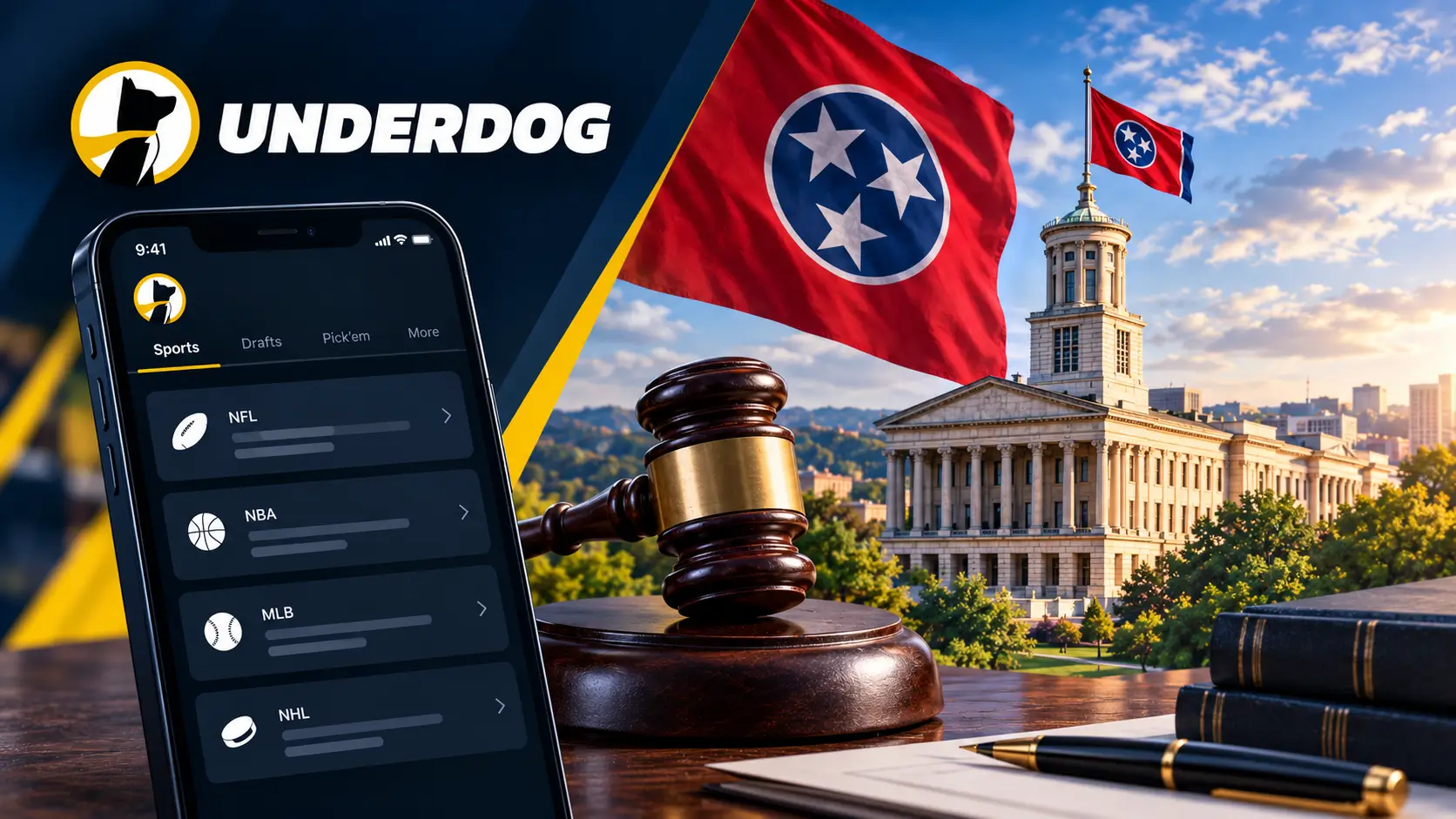
In a new federal lawsuit, Underdog sues Tennessee, fighting to protect its sports trading app for local customers. Days earlier, state regulators told the company to withdraw its sports contracts.
Fact checked by Paige Williams
Editorial Statement: At CasinoUS, we independently review and select the online casinos featured on our site. We assess each operator using consistent criteria covering licensing, security, payments, payouts, bonuses, games, customer support and responsible gambling.
We may earn commissions when readers use certain affiliate links. However, commercial relationships do not determine which casinos we feature or how we evaluate them. We highlight both strengths and limitations so that US players can make more informed decisions.
The whole dispute turns on one question: who gets to regulate these contracts? Underdog says only federal regulators can, while Tennessee treats them as sports bets that need a state license.
If you trade in Tennessee, the result could decide which apps you can still legally use.
The dispute built up over roughly six weeks in 2026.
Each breach could bring a fine between $10,000 and $25,000, the letter said. The state also put the fantasy license of a sister company, Underdog Sports, at risk.
A sports event contract lets you trade on whether something happens in a game.
For example, you might pay 40 cents for a Titans win, and that position usually returns $1 if they win.
The CFTC, the federal regulator for futures markets, oversees the exchanges that list them. Other operators want the same federal status, as the recent ProphetX approval shows.
Both sides read the same federal law in very different ways.
| Issue | Underdog’s position | Tennessee’s position |
| Who regulates | The CFTC alone | Tennessee’s Sports Wagering Council |
| What the product is | A swap traded on a federal exchange | A bet covered by state sports gaming law |
| License needed | No state license | Yes, costing $750,000 up front |
| Legal backing | Commodity Exchange Act and the Supremacy Clause | State betting law, plus September’s appeals ruling |
Underdog wants a judge to say Tennessee’s betting rules cannot touch its exchange. It also wants a lasting order that stops the state from acting.
Recent court rulings make Underdog’s path in Tennessee harder.
In September, the Sixth Circuit said Kalshi failed to prove its sports trades were swaps under federal law. The judges added that states could still enforce gambling laws, and federal judges in Nashville must follow that binding ruling.
However, the Third Circuit reached the opposite view in Kalshi’s New Jersey case. With courts split, three petitions are now waiting on the justices.
Underdog is not waiting for states to move first.
In September, it took Ohio, Wisconsin, Washington, New Mexico, Massachusetts and Connecticut to court. By filing first, Underdog forces each state to defend itself in open court.
Money explains much of the pushback: licensed Tennessee sportsbooks pay a 1.85% tax on handle, the total amount bet. Unlicensed prediction markets pay neither that tax nor the license fee.
Licensing risk cuts both ways, though, as MGM dropped its prediction markets plan earlier in 2026. Nevada regulators had warned that its gaming license could suffer.
The case could run into 2027, so a few checks can protect your money.
Licensed apps follow Tennessee gambling laws, which include location checks to prove you are in the state. If that oversight matters to you, the CasinoUS licensed sportsbook reviews compare payout speed, betting markets and bonus terms.
Whatever you choose, deposit limits and other responsible gambling tools help keep trading under control. Also, check the legal gambling age in the USA before you sign up anywhere.
When Underdog sues Tennessee, it raises a bigger national question.
For now, September’s appeals ruling gives Tennessee the stronger hand. Until the Supreme Court weighs in, review state-by-state gambling rules before you trade, because access can change quickly.
 Alex Harper • 10 min
read
 Lara Johns • 10 min
read
 Alex Harper • 10 min
read
 Alex Harper • Oct 15, 2026
 Alex Harper • Oct 14, 2026
 Alex Harper • Oct 14, 2026
 Lara Johns • Oct 13, 2026