Allwyn PrizePicks Revenue Jumps 27% as US Growth Accelerates
 Alex Harper • Aug 27, 2026
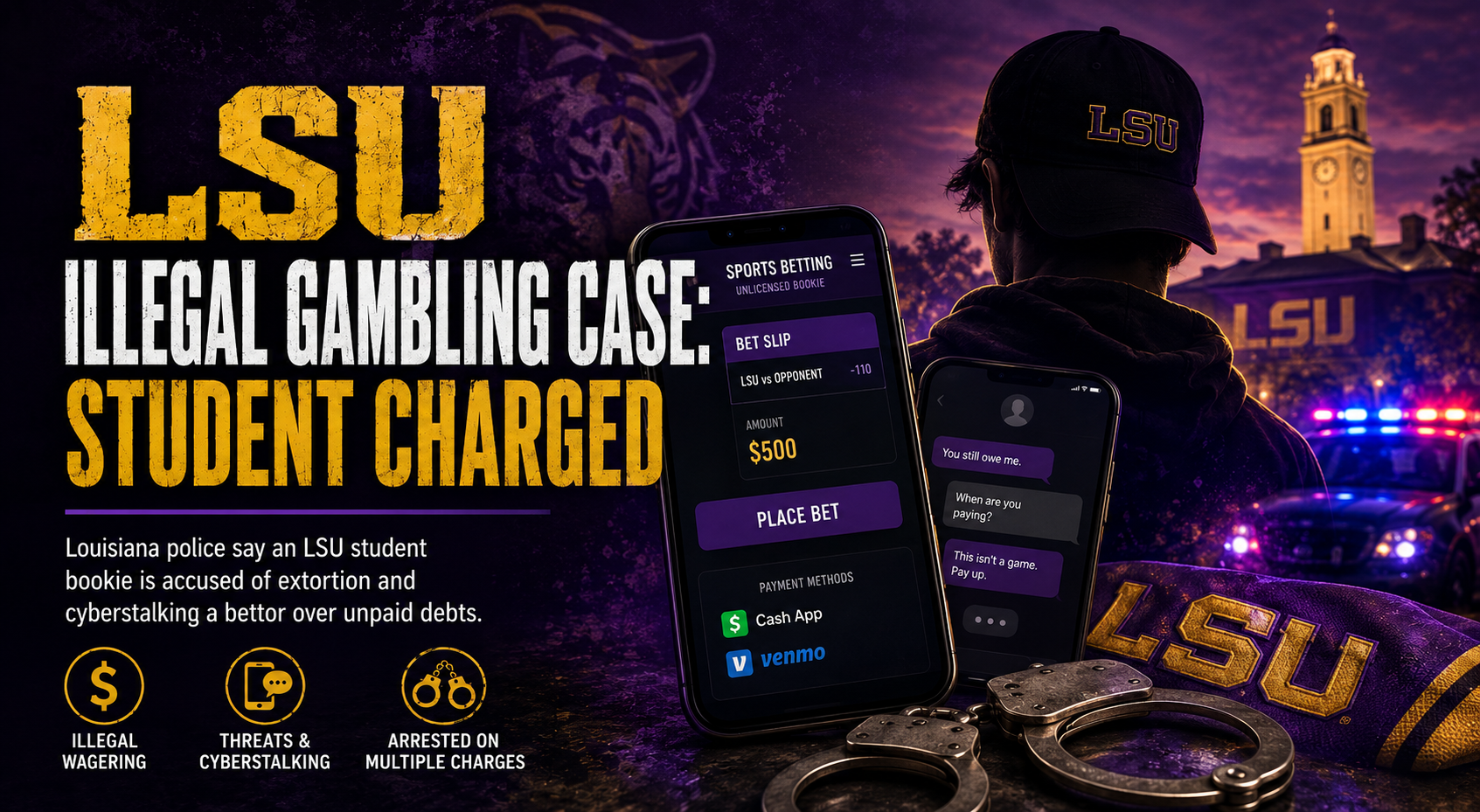

Louisiana State Police arrested an LSU student on Aug. 25 in an LSU illegal gambling case that also includes extortion and cyberstalking charges. Investigators say Joseph Contente, 23, worked as a bookie and threatened bettors who fell behind on payments. The case started with a single complaint. It grew into a months-long financial investigation.
The investigation traces back to a single complaint filed with the Louisiana State Police Gaming Enforcement Division on Jan. 16. A man told troopers he had been placing bets for months with someone going by the name Contente.
Contente ran things informally. Bets came in over text, and he extended a line of credit tied to an online casino called “The Vault.” When bills came due, payment moved through Cash App or Venmo, according to the arrest affidavit.
Trouble started in December 2025, when the man lost a bet he could not cover right away. Contente gave him room to breathe at first, agreeing to push back the deadline, State Police said.
That grace period did not last. Days later, harassment took its place: the man, his family, and his friends started fielding threatening calls and texts from a stranger using a fake name, a number investigators later tied to other victims with similar complaints.
Troopers did not stop at one complaint. A review of Contente’s Venmo turned up more than a year of activity: north of $167,000 moving in as debits and another $147,000-plus coming in as credits, stretching from February 2025 through mid-April 2026, with senders scattered across the Baton Rouge area and beyond state lines.
His Cash App told a similar story, with roughly 100 additional transfers logged between late January 2025 and early April 2026. To investigators, the volume ruled out casual, friends-only betting.
Contente was booked into East Baton Rouge Parish Prison the day of his arrest. A $25,000 bond bought his release, and jail records show him gone from the facility within three days.
He faces six counts, including:
Stories like this show why the betting method matters as much as the bet itself. Licensed operators answer to a regulator, unlike unlicensed sports betting operations. Unlicensed bookies answer to no one.
| Factor | Illegal Bookie | Licensed Sportsbook |
| Regulatory oversight | None | State gaming commission |
| Dispute resolution | None | Formal complaint process |
| Payment protection | Personal apps, no safeguards | Verified, traceable transactions |
| Legal recourse if scammed | Limited to none | Regulator and consumer protections apply |
| Collections practices | Unregulated, can include threats | Governed by law |
A licensed sportsbook cannot legally threaten a customer over a debt. That single difference is why regulators exist in the first place.
This LSU illegal gambling case is a reminder to check who is actually taking the bet. A bookie working through text messages and personal payment apps offers no license, no oversight, and no real protection if a dispute turns ugly.
Choosing a regulated, licensed operator does not just affect legality. It changes what happens when something goes wrong.
 Alex Harper • 10 min
read
Alex Harper • 10 min
read
 Alex Harper • 10 min
read
Alex Harper • 10 min
read
 Alex Harper • Aug 27, 2026
  Alex Harper • Aug 27, 2026
 Lara Johns • Aug 26, 2026
  Lara Johns • Aug 26, 2026
 Editorial Statement: Casino US is your trusted source for timely industry updates, in-depth analysis, and honest operator reviews. Our editorial team brings years of specialized gaming industry knowledge to every story, holding ourselves to strict standards of accuracy and objectivity. We're dedicated to providing straightforward, unbiased, and reliable reporting on the US gambling landscape and beyond.